

Five years ago, at the height of the Covid-19 pandemic, Andrew Cuomo was at the apex of his political power, watched by millions as he delivered daily televised briefings as the governor of New York. Zohran Mamdani, a then-unknown 28-year-old, was running for State Assembly as a democratic socialist in the gentrifying Western Queens neighborhood of Astoria. He would prevail by fewer than 500 votes.
Many flirted with the idea that Mr. Cuomo, a national media star, would replace Joe Biden on the Democratic ticket or run for president in 2024. Ultimately, charges of sexual harassment by 11 women led to Mr. Cuomo’s fall from grace and flight from Albany. At the time, he apologized, but during this year’s mayoral campaign in New York City, he has denied wrongdoing and dismissed the accusations as political. Mr. Cuomo was using the Democratic primary as a vehicle to attempt a comeback and resuscitate his political career.
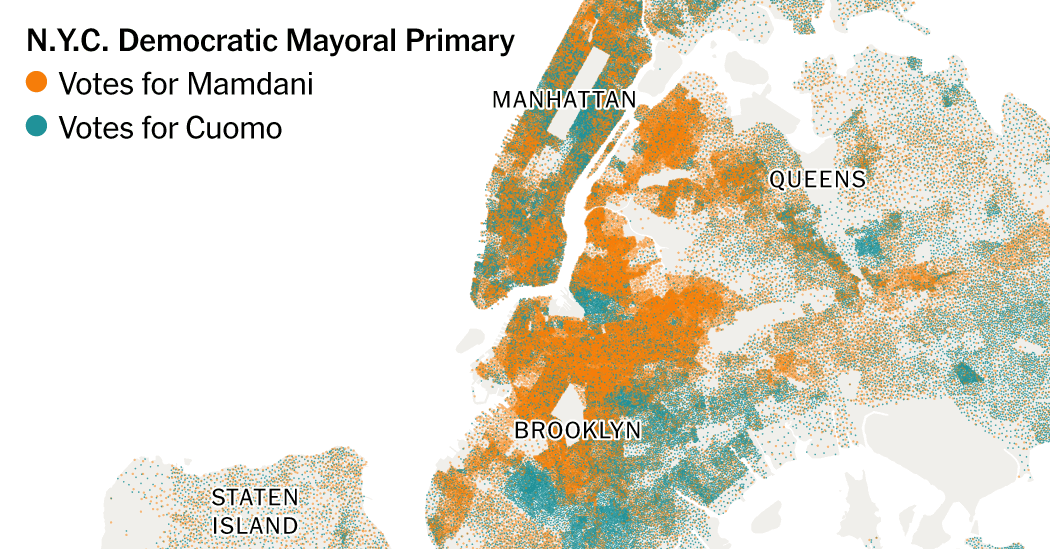
Until Tuesday night. As the polls closed across the five boroughs, it quickly became clear that Mr. Mamdani would trounce Mr. Cuomo, winning the most votes in Brooklyn, Manhattan and Queens. According to a preliminary Times analysis of the first-rank vote, with 93 percent of the votes in, Mr. Mamdani led in majority-white precincts by five points, in majority-Hispanic precincts by six points, and in majority-Asian precincts by 15 points.
In assessing the Cuomo and Mamdani clash, it is difficult to capture the infinite nuance of New York City’s electorate. Nonetheless, to better understand the city’s rich variety of neighborhoods, with all their ethnic groups, wealth profiles, cultural backgrounds and demographics, I have sorted every Assembly district in the five boroughs into seven factions.
The competing voter bases of the Democratic primary for mayor
While Mr. Cuomo’s core coalition bookended the ends of the economic spectrum (the wealthy and the poor), Mr. Mamdani’s coalition was the in-between (working-, middle- and upper-middle-class renters spanning white, Hispanic and Asian neighborhoods). Rooted in ideology, age and a relentless cost-of-living message, Mr. Mamdani’s unique campaign outperformed expectations across the five-borough mosaic.
Here, I will take the reader through the coalition of voters that delivered Mr. Mamdani this stunning political upset — neighborhood by neighborhood.
At a raucous rally in Manhattan last week, amid a sea of yellow bandannas, “Freeze the Rent” signs and “A City We Can Afford” banners, Mr. Mamdani took the stage to a groundswell of applause. He spoke of a new day dawning on the horizon: a changing of the political guard, a different Democratic Party and a reckoning for the complacent political establishment.
He had relentlessly campaigned on the cost-of-living crisis, proposing measures such as freezing the rent for every rent-stabilized tenant, making buses “fast and free,” creating a network of municipally owned grocery stores and funding universal child care by expanding taxes on the wealthy. In the opening days of Mr. Trump’s second term, Mr. Mamdani offered a voice to a generation who did not see themselves in their leaders. His social media videos — across TikTok, X and Instagram — routinely went viral, inspiring thousands of young people, who turned out in record numbers during the early voting period.
By June, Mr. Mamdani could walk the streets of Inwood and Washington Heights — majority-Hispanic neighborhoods in Upper Manhattan that swung hard toward Mr. Trump last November — and be stopped by Spanish-speaking passers-by, eager to take a picture with “the next mayor.” He has proved to be the rare politician capable of expanding the electorate, particularly impressive in a historically low-turnout, off-year primary.
To many New York voters, Mr. Cuomo embodies the flaws of the Democratic Party establishment. Although he attempted to rebrand himself as a “pragmatic progressive” during this campaign, he remained an avatar for the old guard that dominated New York politics for decades: labor unions, real estate developers and the financial elite. Much of the local Democratic establishment sided with him. His aligned super PAC, Fix the City, raised more than $25 million, a third of which came from former Mayor Michael Bloomberg, the largest sum of outside money ever in a New York City mayoral race. If the 67-year-old Cuomo, who hasn’t ruled out an independent candidacy in the fall, is elected, he will become the oldest mayor in the city’s modern history.
Yes, Mr. Cuomo performed well with middle-class Black voters, but that was at least in part because the Black electorate in New York is older than the Hispanic and Asian electorates. With almost every other group, Mr. Mamdani’s performance across the city was a profound improvement on that of Bernie Sanders and other progressive and socialist candidates. Mr. Mamdani performed relatively well in several affluent neighborhoods where Mr. Sanders struggled, like Park Slope and Morningside Heights. He won a plurality of the Hispanic vote, in addition to sweeping many Gentrifying Battlegrounds in Central Brooklyn and Upper Manhattan, and only trailed Mr. Cuomo by 9 points in Staten Island, performing best along the racially mixed North Shore and in union-dense, home-owning precincts. Furthermore, Mr. Mamdani made pronounced inroads with Asian voters, particularly in Queens, performing well in immigrant-heavy enclaves that shifted toward Mr. Trump in November.
Many pundits and operatives doubted Mr. Mamdani’s core strategy of pursuing younger voters, who historically have voted at lower rates. But on Tuesday, they flocked to the polls, won over not just by his videos, but also by his vast canvassing operation (all told, the Mamdani campaign claims to have knocked on over 1.5 million doors). To the youngest generations of New Yorkers, Mr. Mamdani became ubiquitous. His volunteers hosted picnics and social gatherings, where many of his followers found people with compatible politics to date, unmediated by algorithms. For years, this cohort represented a sleeping giant in local politics, with enormous untapped potential. On Tuesday, they were the engine that appeared to have toppled a political dynasty.
Mr. Mamdani used the dollars piling up against him as a call to action: “They’ve got all the money in the world,” he told his supporters, “and we’ve got you.”
Since November, the Democratic Party has been searching for an answer to Mr. Trump. Democrats in other corners of the country may be inclined to overlook Mr. Mamdani’s spectacular campaign, believing his economic populism and urban appeal are a poor fit for swing districts in suburban and rural communities. But as Mr. Mamdani told his supporters at a taproom in Long Island City on election night, quoting Nelson Mandela, “It always seems impossible until it is done.” The city’s youngest generations gave Mr. Mamdani his shocking success Tuesday night. To crown him mayor, they’ll have to do it all again in a general election featuring the current mayor, Eric Adams; the Republican nominee, Curtis Sliwa; and, perhaps, Mr. Cuomo, looking for a second chance at a comeback. But Mr. Mamdani’s coalition — the unlikely voters and the energized young people of New York City — is not only here to stay, but growing by the day.
