

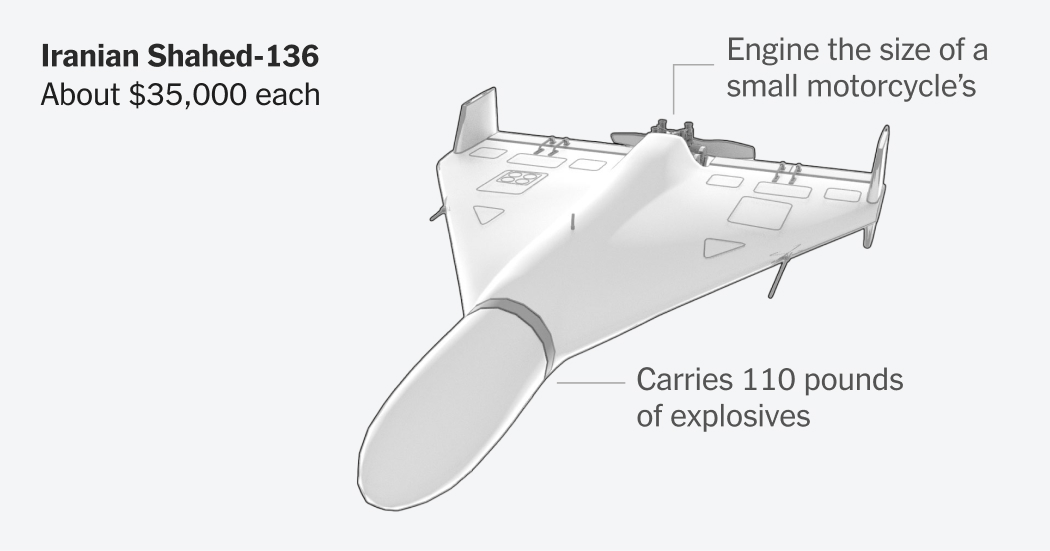
A 3-D rendering of an Iranian Shahed-136 drone, a device with two triangle-shaped wings attached to a central fuselage. It has an engine the size of a small motorcycle’s and carries 110 pounds of explosives.
Engine the size of a small motorcycle’s
Carries 110 pounds of explosives
One of the biggest takeaways of the war with Iran is that it has proven itself to be a surprisingly capable adversary against the United States. In addition to its willingness to go on the offensive, Iran has forced the U.S. and its regional allies to confront the rise of cheap drones on the battlefield.
Iranian drones, made with commercial-grade technology, cost roughly $35,000 to produce. That is a fraction of the cost of the high-tech military interceptors sometimes used to shoot them down.
Cheap drones changed the war in Ukraine, and they have enabled Iranians to exploit a gap in American defense investments, which have historically prioritized accurate but expensive solutions.
Countering drones has been a major priority for the Pentagon for years, according to Michael C. Horowitz, who was a Pentagon official in the Biden administration. “But there has not been the impetus to scale a solution,” he said.
In just the first six days, the U.S. spent $11.3 billion on the war with Iran. The White House and Pentagon have not provided updated estimates, but the American Enterprise Institute, a conservative-leaning think tank, estimated in early April that the U.S. had spent approximately between $25 and $35 billion on the war, with interceptors driving much of the cost. Many missile defense experts also fear interceptor stockpiles are now running dangerously low.
Here is a breakdown of some of the ways the U.S. and its allies have countered Iran’s drones, and why it can be so costly.
Air-based strikes
In an ideal scenario, an early warning aircraft spots a drone when it is still several hundred miles out from a target, and a fighter jet, like an F-16, is dispatched from a military base. The F-16 can then use Advanced Precision Kill Weapon System (APKWS) II rockets to shoot a drone from about six miles away.
A 3-D rendering of an F-16 fighter jet firing an APKWS II rocket from under one wing. Two to three rockets are fired per drone, as per air defense protocol. Two APKWS II rockets and an hour of F-16 flight cost approximately $65,000, a little less than twice that of the Iranian Shahed-136.
Two to three interceptors fired per drone
These types of defensive air patrols are cost-efficient, but haven’t always been available because of the vast scope of the conflict. Iran has also targeted early warning aircraft that the U.S. needs to detect a drone from that distance, according to NBC News.
The other option for detecting and shooting down drones is a variety of different ground-based detection systems, but these systems are all at a disadvantage, as their ability to spot low-flying drones is limited by the curvature of the earth.
Anti-drone defense systems
One ground-based defense system the U.S. and its allies have built specifically to counter drones at a shorter range is the Coyote. It can intercept drones up to around nine miles away.
A 3-D rendering of a Coyote Block 2 interceptor, which looks like a three-foot tube with small rockets at one end. Two Coyotes cost approximately $253,000 or about seven times that of the Iranian Shahed-136.
The Coyote is significantly cheaper than many of the other ground-based defense systems available to the U.S. and its allies and historically effective at defending important assets. But despite being both effective and cost-efficient, relatively few Coyotes have been procured by the U.S. military in recent years.
When Iran-backed militias launched attacks on U.S. ground troops in the region in 2023 and 2024, there were so few Coyotes available that troops had to shuffle the systems between eight different bases in the region almost daily, according to a report from the Center for a New American Security, a Washington think tank.
Ship-based anti-missile defenses
Many of the longer-range ground-based defense systems the U.S. and its allies can use to combat drones are more expensive, as they are designed to shoot down aircraft and ballistic missiles, not drones. A Navy destroyer’s built-in radar system, for instance, can detect drones from 30 miles away and shoot it down with Standard Missile 2 (SM-2) interceptors. As in the air-based strikes, military protocol stipulates that at least two missiles be fired.
A 3-D rendering of the deck of a Navy destroyer firing an SM-2 missile from a built-in launcher, which looks like a 15-foot missile launching from a grid of openings on the ship’s surface. Two SM-2 missiles cost approximately $4.2 million, about 120 times that of the Iranian Shahed-136.
This misalignment between America’s defense systems and current warfighting tactics started after the Cold War, when the anticipated threats were fewer, faster, higher-end projectiles, not mass drone raids.
Iran often launches multiple Shahed-136 drones at a time, given their low price tag. The drones are also programmed with a destination before launch and can travel roughly 1,500 miles, putting targets all across the Middle East within reach.
“This category of lower-cost precision strike just didn’t exist at the time that most American air defenses were developed,” said Mr. Horowitz.
Ground-based anti-missile defenses
The Army’s standard air-defense system is the Patriot. Typically stationed at a military base, it can shoot down a drone from up to around 27 miles away with PAC-3 Missile Segment Enhancement interceptors. Military protocol stipulates that at least two missiles be fired.
A 3-D rendering of a Patriot launcher loaded with 17-foot PAC-3 MSE missiles, which looks like a tilted shipping container with scaffolding. Two PAC-3 MSE missiles cost approximately $8 million, about 220 times that of the Iranian Shahed-136.
Patriot missile defense system
Air defense training teaches service members to prioritize using longer-range defense systems first to “get as many bites at the apple as you can,” but those are the most expensive, said Stacie Pettyjohn, a senior fellow and director of the defense program at the Center for a New American Security.
But a costly defense can still make economic sense to protect a valuable target, especially those that are difficult to repair or replace, such as the nearly $1.1 billion radar at a military base in Qatar and the $500 million air defense sensor at a base in Jordan that were damaged early in the conflict.
Ground-based guns
Finally, there is what one might call a last resort: a ground-based gun. When a drone is about a mile away or less than a minute from hitting its target, something like the Centurion C-RAM can begin rapidly firing to take down the drone.
A 3-D rendering of a Centurion C-RAM, which looks like a gun mounted to a rotating, cylindrical stand. The gun fires 75 rounds of ammunition per second. Five seconds of firing the gun costs $30,000, slightly less than a single Iranian Shahed-136.
Centurion Counter-Rocket, Artillery and Mortar
Fires 375 rounds of ammunition in 5 seconds
Even though it is fairly cost-effective, the Centurion C-RAM is not the best option because it has such a short range.
Interceptor drones
There’s also what one might call the future of fighting drones: A.I.-powered interceptor drones. Interceptor drones like the Merops Surveyor can theoretically hunt and take down enemy projectiles from a short range.
A 3-D rendering of a Surveyor drone, which looks like a three-foot tube with wings and a tail. The Merops drone costs approximately $30,000, a little less than a single Iranian Shahed-136.
Merops system: Surveyor drone
Eric Schmidt, the former Google chief executive, founded a company to develop the Merops counter-drone system in conjunction with Ukrainian fighters, who have already been combatting Iranian drones in the war with Russia for years.
The U.S. sent thousands of Merops units to the Middle East after the conflict began, but it is unclear whether they have been deployed. The military set up training on the system in the middle of the war, as reported by Business Insider.
Other attempts to lower the cost-per-shot ratio of taking out a drone have failed.
The Pentagon invested over a billion dollars in fiscal year 2024 researching directed energy weapons, or lasers, that would cost only $3 per shot and have a range of 12 miles. Those systems have yet to be used in the field.
Despite the cost imbalance, the real fear for many in the defense community is the depleted stockpile of munitions.
“What scares me is that we will run out of these things,” said Tom Karako, the director of the Missile Defense Project at the Center for Strategic and International Studies in Washington. “Not that we can’t afford them, but that we’ll run out before we can replace them.”
