

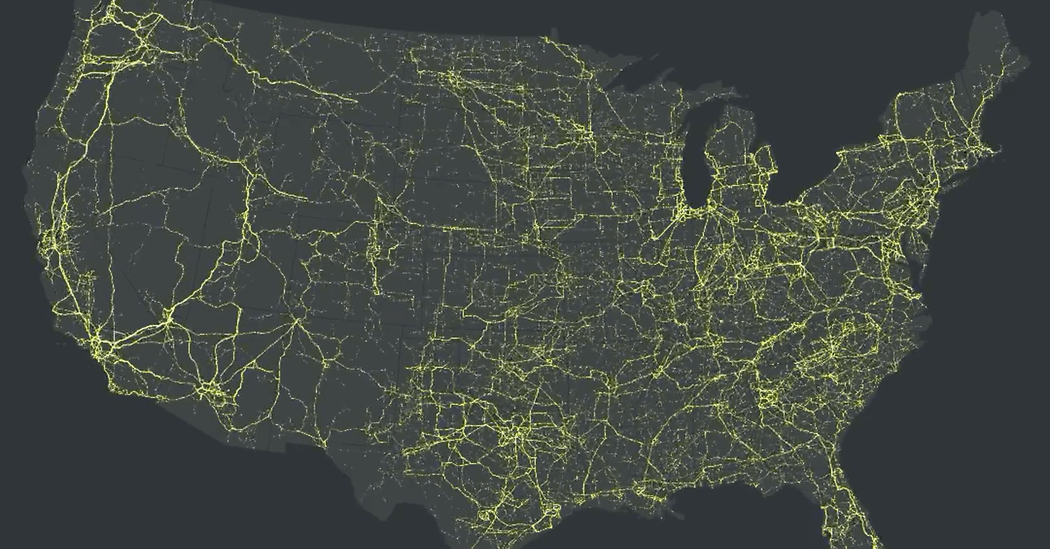
This is the backbone of
America’s electrical grid.
It is a sprawling patchwork of dated infrastructure, increasingly unsuited to our needs.
Artificial intelligence’s rapid growth is stoking concerns about the impact hundreds of new data centers could have on electricity prices and the grid.
But data centers are a wake-up call. A surge in demand could fuel the kind of investment that the grid has needed for decades.
Electricity is perhaps the most underrated issue of our time.
In the United States, we have been blessed with a power grid that instantly responds whenever you flick on the lights. It works mostly as expected, cooling our homes, charging our laptops and phones, running life-saving equipment. But as we plug more things into the grid, it will come under unprecedented strain. Virtually every economic goal that American politicians might strive for — growing the economy, reinvigorating the manufacturing sector, fighting climate change or just making life more affordable — will require big upgrades to the electricity system.
Lately Americans have become fixated on the explosion in data centers and the power needs of artificial intelligence. That is actually a small part of a much bigger problem. Our grid is too old and our supply of electricity too small. If we don’t meet this moment, we will face an impoverished future of more expensive, less reliable energy, and slower economic growth. In a worst-case scenario, we could see Americans defect from the grid entirely, raising costs for everyone. Something needs to change now.
If you want to fix the grid, you first have to understand it. The place to start is your electricity bill.
Electricity prices have shot up over the last five years
18 cents per kilowatt hour
Average retail electricity price
Residential prices have risen by more than 30 percent since 2020
The price will likely keep rising. Over the past year, wholesale electricity prices — that’s what utilities and big electricity customers pay to buy and sell electricity on a day-to-day basis — have gone up. While it can take years for those wholesale price changes to show up in your power bill, they will eventually.
Electricity is already the second biggest energy expense on average that Americans pay each year, second only to gasoline.
While some inflation is unavoidable, electricity inflation is particularly harmful to America’s economic and environmental goals. It makes any kind of big business investment — such as a new factory or office building — more costly. And when people feel as if their electricity rates are surging and unpredictable, it can discourage them from switching to electric vehicles or electric appliances that cut air pollution and carbon emissions.
Our new age of electricity inflation is driven by an important change: For the first time in more than a decade, American electricity demand is steadily growing. The country’s largest regional power market, which covers the Mid-Atlantic and upper Midwest, is likely to set a new all-time demand record this summer. National electricity use will also likely set an all-time high.
Electricity demand has started rising faster again
Change in electricity sales
In other words, Americans may be about to use more electricity than they ever have. This might sound obvious — of course U.S. electricity use grows year over year — but it is actually a really big deal. Why? Partly because the past 15 years have been an incredibly anomalous time for the power system.
For more than a century, electricity demand rose during periods of economic growth. From the power grid’s inception in the late 19th century to the mid-2000s, America’s hunger for electricity grew more or less in pace with the economy.
Then, in the mid to late 2000s, something unusual happened: America’s electricity demand stagnated. This slowdown wasn’t chiefly because of the aftermath of the 2008 financial crisis. Instead, it was technological: Americans adopted more efficient lightbulbs — switching to compact fluorescent lights and LEDs from incandescent lightbulbs — and suddenly needed less electricity to run them. Even as the economy shifted back into growth mode in the 2010s, the huge efficiency gains from this transition overwhelmed big increases in electricity demand.
The amount of these savings has been enormous.
Residential electricity by use
Around 2000, lighting was the single largest use of electricity in American homes. By 2018, energy-efficient lightbulbs had shrunk the category to sixth place.
Energy forecasters expect that electric vehicles will come to dominate residential power use over the next few decades, contributing to an increase in overall electricity use.
Some parts of the country, such as Texas, have seen electricity demand rise anyway during the past 20 years, thanks to a booming population and economic growth. Because of this, their grids are in some ways better prepared to absorb the next wave of new demand. But in many other places, the end of the LED revolution will force utilities to adapt to a new era.
At the same time, there is, of course, the explosive growth of A.I. and data centers, which will drive a new surge of demand as well.
Lighting also dominated commercial activity use until about 2015.
But it’s now changing fast. The explosive growth of data centers will help drive electricity use higher than ever.
All of this rising demand will eventually mean higher prices unless we build more power generation in the years to come.
But that is not the whole story. There is another driver of high prices that has little to do with electrical demand. It is the cost of operating and fixing the power grid itself.
The power grid does not work in the way that many people expect. For a long time, when I paid my power bill, I assumed that most of my payment went to generating the electricity I had just used. In fact, the cost of operating and maintaining the power grid itself — moving electricity over long distances, then delivering it to homes and businesses — makes up a growing share of bill costs.
These system costs can raise prices, which can then drive demand. This is why states that have seen electricity demand grow the most since the pandemic — such as North Dakota and New Mexico — have seen their electrical prices grow the least and sometimes even decline. Meanwhile, the states where demand dropped — such as California and Maine — saw their prices grow the most.
In recent years, higher demand has not necessarily led to higher prices
The continental United States does not have a single national power grid; instead, electricity is generated and transmitted through three regional grids, then delivered to homes and businesses by one of several thousand local utilities. Each state technically regulates its own electricity system; in practice, some have much more authority to do so than others.
Since 2019, the cost of the poles and wires in the local distribution system has ballooned in some states. In particular, California and the southeast have had to invest billions in their distribution grid.
Utilities are spending less on creating electricity and more on moving it around
Spending by electric utilities
Natural disasters have driven the worst of these costs. After California’s power grid ignited several deadly fires in the last decade, the state undertook a costly process to lay underground lines, install weather stations and build automatic shut-off equipment to prevent future blazes. The South, meanwhile, has had to rebuild parts of its grid after extreme storms destroyed large swaths of it.
These disaster-exposed states had to rebuild the last-mile distribution system that delivers power to homes and businesses. That increased their system costs, which drove up the cost of electricity and pushed their residents to use less power overall.
But every state will have to rebuild swaths of its grid soon. Much of America’s distribution equipment is decades old and would be nearing the end of its life around now anyway. We will also need to upgrade and expand the transmission system, which sends electricity over long distances from power plants to towns and cities.
Of course, sometimes the cost of generating electricity can go up, too, and will help spike power bills.
Burning natural gas, a fossil fuel, is the primary way that America generates electricity. After Russia’s full-scale invasion of Ukraine, liquefied natural gas prices surged around the world. New England, which relies more on liquefied natural gas imported by ship than other parts of the country, saw its power costs increase, too. These convulsions could happen again soon, with liquefied natural gas prices rising as a consequence of the war in Iran.
If natural gas moved by pipeline were to get more expensive — thanks, perhaps, to booming exports outstripping the country’s available supply — much of the country could see its electricity prices spike.
The East Coast and the South are vulnerable to shifts in the price of natural gas
Electricity inflation, in other words, can happen in many ways. Sometimes the system needs to be rebuilt. Sometimes fuel costs rise. And sometimes electricity demand simply exceeds supply, forcing more money to chase less electricity. In some parts of the country, such as the Mid-Atlantic and the upper Midwest, data center growth has driven projected supply shortfalls and helped to drive up electricity prices.
These price increases have in turn helped fuel a backlash to data centers. At the local level, self-organized pushback has helped cancel or stall dozens of data center projects nationwide. Senator Bernie Sanders of Vermont and Representative Alexandria Ocasio-Cortez of New York have proposed a national pause on all data center construction in part to stem growing electricity demand.
The concern around these data centers is understandable. But at least when thinking about the power system, we need to walk a fine line: We should welcome the growth of electricity demand, but seek to slow electricity inflation. Although it sounds counterintuitive, when a big new electricity customer shows up on the grid, it can sometimes help keep power costs down for everyone else, because it buys so much power that it can cover much more of the system’s costs, keeping a lid on rising power rates.
There’s a way out of our electricity crisis. Politicians should begin by recognizing that fighting and blocking individual data centers, while prudent in some cases, will not solve the deeper problems. There’s no question that data centers are pushing up America’s electricity use. But over the past year, data centers have become far less dependent on utilities and the power grid. That’s because many new data centers are now constructing huge on-site natural gas power plants and grid-scale battery installations, which will allow them to wait out the years that it might take for them to get approval to connect to the grid proper.
The data center buildout, in other words, is happening somewhat independent of the grid itself. Additionally, data center developers are flocking to Sun Belt states where it’s harder for Democratic politicians — and local residents — to block a project.
We should not want a system of two parallel power systems: a fossil-fuel-intensive grid used by data centers, and an aging one used by everyone else. Since we can’t solve the grid crisis by blocking the data center buildout, we should focus on harnessing that buildout to improve the power grid overall. Some of the economy’s richest and most innovative companies are willing to invest in new power plants and improve the grid’s infrastructure. That is a generational opportunity.
To seize it, our leaders need a strategy.
First, leaders should treat the grid as the critical infrastructure it is — on par with the interstate highway system as an essential platform for growth. One priority should be reforming the companies and organizations that govern many of our country’s power markets and are often woefully unfit for the task. Right now, the grid is planned either by local utilities themselves or by regional grid authorities that are often dominated by utility interests. Often that means they take too long to hook up new power plants and underinvest in large-scale transmission projects that would cut electricity costs for consumers — but that would also undercut their monopoly power. It can also keep independent companies from making big investments in the power system’s future, which could increase the existing infrastructure’s flexibility.
The government should take a renewed interest in ensuring that these utilities cannot dominate planning the future of the grid. This may involve reforming regional grids and making their decisions more transparent to the public. Enforcing traditional antitrust rules may also relieve some pressure: A for-profit utility should not be allowed to own both a power plant and the infrastructure that delivers fuel to that power plant.
Next, recognize that we will simply need more electricity to meet our needs. Congress must pass permitting reform this year to make it easier for governments and companies to build new solar farms, wind farms and power lines. It needs to yank authority from the president to block energy projects that have already been approved and end President Trump’s de facto block on all new renewables.
States and the federal government should also work together to escape the scarcity trap that ensnares our grid. Right now, any investment in the grid is borne mainly by electricity customers through their power bills. If your utility builds a big new power plant that generates an excess of cheap, clean electricity, then your bills will go up, not down, in the short term, as you “pay off” that investment — even if wholesale power gets cheaper.
The government can help by stepping up and covering some of these costs directly. Politicians should pursue efforts to build new large-scale nuclear power plants at scale, in a repeatable way, and at public expense. Nuclear is an especially good candidate for this investment because it has bipartisan support and generates no carbon emissions. The Trump administration and Gov. Kathy Hochul of New York have pursued early efforts to build new nuclear reactors; the Department of Energy should consider helping other public entities such as the Tennessee Valley Authority or the federal power authorities to build their own projects.
As for data centers, we can adopt some immediate tactics to keep them from overwhelming the grid, while using their size and scale to help build the infrastructure we need for the long term.
Mr. Trump has asked tech companies to sign a voluntary, toothless Ratepayer Protection Pledge swearing their power needs won’t overwhelm the grid. Tech companies should instead be made to finance long-term improvements to the grid by contributing to a national grid modernization fund. This fund could then build new large-scale power lines or buy next-generation power equipment in bulk. It could also build batteries at the neighborhood level, set up programs that pay households to be more flexible with their power use and make targeted improvements so that our existing wires and equipment can handle more power.
Lastly, the government should establish a new federal grid authority that can build a long-distance, high-voltage transmission grid across the country to move electricity to the places that need it from the places that produce it. This new institution should be empowered to overcome local and utility opposition to procure the cheapest power for the greatest number of Americans. This grid authority might already be possible to form through executive authority alone, although Congress could also authorize such an effort. It could also partly be funded by the new grid fund.
This project would help keep power costs low for every American, reducing strains in those rural and exurban areas suffering from the biggest data center expansions while allowing the whole country’s economy to benefit from the true blessing of solar, wind and battery power.
There aren’t many 120-year-old machines that most Americans use every day — but the power grid is one of them. Our leaders have a rare opportunity to rejuvenate this aging but essential system for another century of growth.
Methodology
Transmission line data is from the Homeland Infrastructure Foundation-Level Data, which was last publicly updated in 2024. Data center locations are from Cleanview and include only data centers 1 GW and larger.
Energy consumption by use data is from the U.S. Energy Information Administration. It includes only single-use categories and excludes “other uses.”
