

The conflict in the Middle East provided a painfully awkward backdrop to this week’s meetings between President Trump and China’s leader, Xi Jinping.
Mr. Trump, waging war on Iran, is also trying to cut off Iran’s income from oil exports. China is by far the world’s biggest customer for that oil. Mr. Trump’s Treasury secretary, Scott Bessent, has accused China of effectively financing terrorism by purchasing Iranian oil.
So last month, the U.S. Navy deployed a vast sea blockade, starting in the Gulf of Oman, giving it the power to decide which ships get through to China and other destinations in Asia.
U.S. officials say the blockade has been very effective, having intercepted more than 70 vessels. Ships have been stopped off Iran’s coast and even far beyond. One China-bound ship carrying Iranian oil, the Majestic X, was recently seized in the Indian Ocean, more than 2,000 miles from the Gulf of Oman.
A complete picture of ship traffic in the region is difficult to ascertain. Ships routinely turn off their location trackers, use spoofing to falsify positions and sail under false flags. Or they transfer Iranian oil from one ship to another smaller ship, making its origin hard to detect. Sometimes vessels deploy all of those tactics together. Between April 19 and May 3, there was a 600 percent increase in the number of ships engaged in deceptive tactics, according to Windward, a maritime intelligence firm.
But what is clear, according to a New York Times analysis of satellite images and other shipping data, is that some ships carrying Iranian oil that left around the time or after the U.S. blockade was implemented are now nearing East Asia.
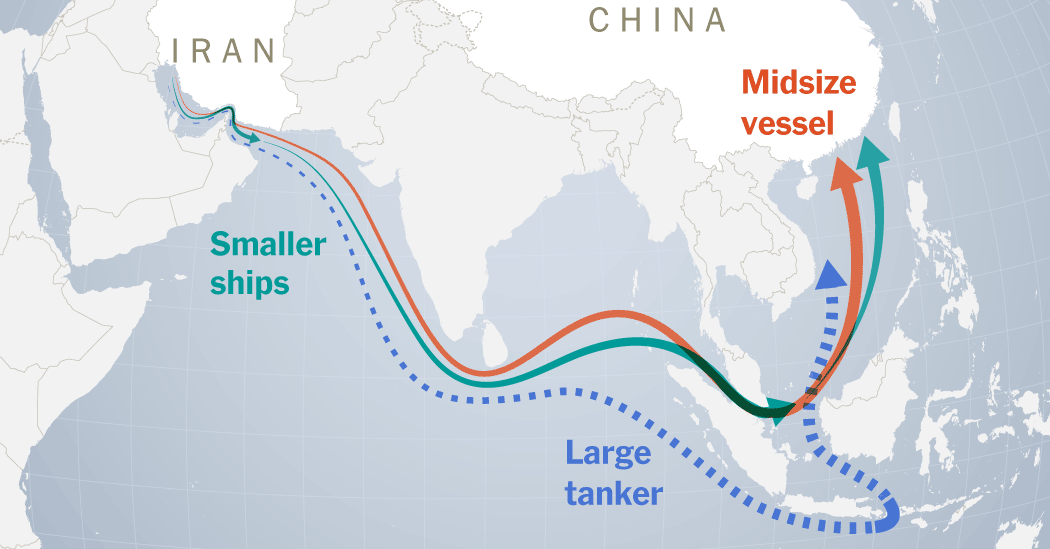
Here are three ships that illustrate how Iranian vessels are heading toward China.
The Huge: A large Iranian ship operating with its location tracker off, taking an uncommon route
The Huge, an Iran-flagged oil tanker, loaded oil at Kharg Island, Iran’s primary crude oil export terminal, and transited the Strait of Hormuz in early April, according to satellite images. It then appeared to have left the Gulf of Oman, passing the blockade around when it started on April 13.
Throughout the large tanker’s journey, its location tracker was off. The ship, laden with about two million barrels of Iranian crude, turned its tracker on briefly in early May, when it appeared off the coast of Indonesia in the Lombok Strait.
Capt. Tim Hawkins, a spokesman for the U.S. Central Command, said the U.S. government does not consider the Huge as having evaded its forces because it passed before the blockade began. Yet U.S. forces seized at least one tanker carrying Iranian crude that left the Gulf of Oman before the blockade was imposed: the M/T Tifani, which the U.S. military boarded in the Indian Ocean on April 21.
The Huge, for its part, continued onward, appearing near Sri Lanka on April 23, according to satellite images. Its path through Southeast Asia, via the Lombok Strait and not the more commonly used route, the Strait of Malacca, is notable. More Iran-linked ships, facing intense scrutiny, are taking this route to reduce their visibility, according to Ami Daniel, the chief executive of Windward.
Mr. Daniel said he believes that ships that are making it out of the Gulf of Oman are doing so through agreements with the U.S. government, which has issued waivers for certain ships for humanitarian or other reasons.
“I think the amount of focus and energy on this blockade is unprecedented, and I don’t believe you can just walk away from the Strait of Hormuz without being noticed with a 300-meter tanker,” Mr. Daniel said.
Satellite images taken on Wednesday showed that the Huge was heading north, past Vietnam, and likely going to China, according to Ying Cong Loh, an analyst at Kpler, a maritime data firm. It could be heading toward waters near Hong Kong, where ship-to-ship transfers of Iranian crude have taken place, he said.
The Atomis: A midsize vessel that arrives in Chinese waters
A midsize ship, the Atomis, an oil tanker subject to U.S. sanctions, left its location tracker on for most of its journey from Iran across the Indian Ocean.
But the ship, flying a false flag of the African nation Comoros, appears to have used spoofing at the beginning and end of its journey, meaning that it manipulated its tracking data to make it seem as if it were somewhere it was not. On April 2, satellite images show it loading at Iran’s Kharg Island while tracking data placed it in Kuwait.
Captain Hawkins said that spoofing has not impeded the U.S. Navy’s ability to enforce the blockade. While these ships can be hard to keep tabs on using only tracking data, the U.S. government has multiple ways to monitor ships. Those include radio frequency data and satellite imaging that uses radar signals, rather than light, according to Hans Tino Hansen, chief executive of Risk Intelligence, a maritime risk firm.
Around April 13, the Atomis, which had changed its name from the Divit a day earlier, passed the U.S. blockade and crossed the ocean, with its location tracker on, to a holding spot near Hong Kong where it will likely transfer its cargo to another ship, according to Bridget Diakun, a maritime risk analyst at Lloyd’s List, a shipping publication.
The Salute Legend: A smaller vessel that seems to receive a ship-to-ship transfer
Smaller vessels, often with their location trackers off, have been most likely receiving Iranian cargo in ship-to-ship transfers in the Gulf of Oman. The U.S. government does not consider such transfers to be violations of the U.S. blockade, which, according to the U.S. Central Command, is focused on ships entering or leaving Iranian ports.
For example, the Salute Legend, a smaller vessel with a Hong Kong flag, used spoofing to obscure its location. Because of that, it’s likely but not certain that the ship received a transfer of cargo in the Gulf of Oman from another ship with cargo from Iran, according to Lloyd’s List. The ship’s transponder was on as it moved east before docking at a port in Quanzhou, China.
In addition to the Salute Legend, there have been at least eight smaller ships with links to Iran that have moved from the Gulf of Oman to Asia since the start of the U.S. blockade, according to a Times analysis. It was unclear what or whose cargo those ships were carrying. Half of those may have been involved in ship-to-ship transfers in the Gulf of Oman, as well as off the coast of Malaysia, a longstanding location for ship-to-ship transfers.
Still, to understand just how effective this blockade has been, analysts point to the dwindling amounts of Iranian crude stored on tankers near the coast of Malaysia, where millions of barrels of crude are illicitly transferred between tankers every day.
Most of the oil being transferred there is not being replenished. There are 51 million barrels of Iranian oil floating on tankers in the region, down from about 85 million barrels in early February, according to Kpler.
