

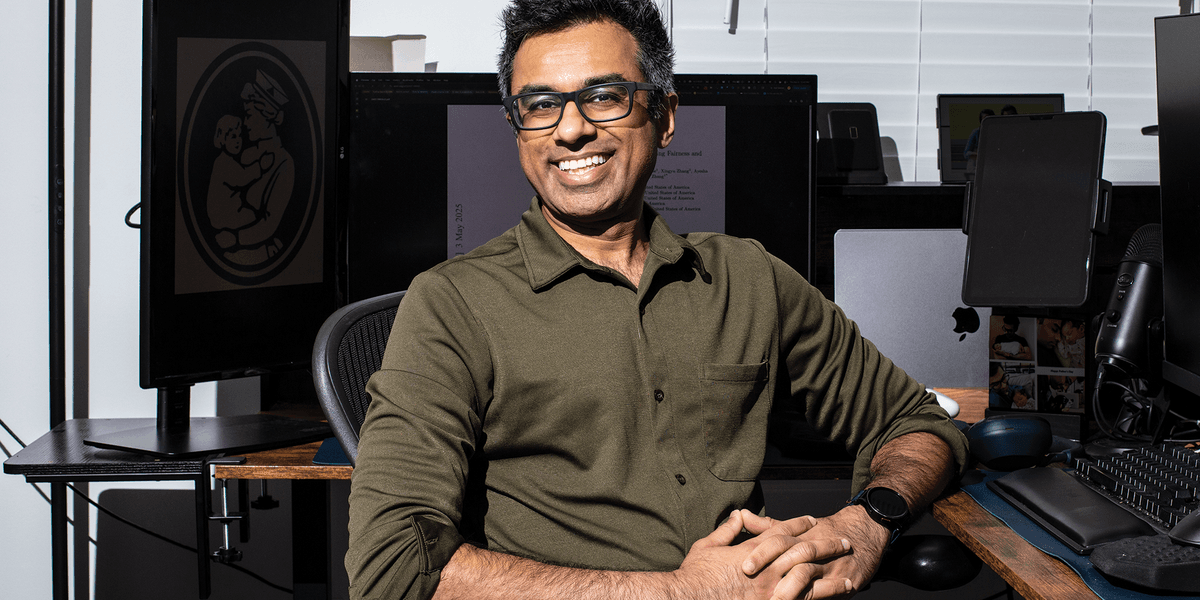
When Boston Kids’s Hospital posted a job itemizing for a immediate engineer in 2023, Dinesh Rai determined to use. He didn’t anticipate to get the job.
On the time, immediate engineering was being touted as one of many sizzling new jobs created by generative AI. Corporations needed individuals who knew coax the perfect solutions from large language models (LLMs) by fastidiously wording directions, supplying examples, and giving the programs personas or different context.
Dinesh Rai
Employer:
Boston Kids’s Hospital
Occupation:
Medical AI Engineer
Schooling:
Bachelor’s diploma in supply-chain administration and advertising sciences, Rutgers Enterprise Faculty; Physician of Medication, Albert Einstein Faculty of Medication
It was an uncommon function for a hospital, however Rai had an uncommon résumé. Whereas he was educated as an emergency doctor, he had additionally taught himself to code simply earlier than coming into medical college. After finishing a fellowship in medical informatics—which focuses on the intersection of medical apply and IT programs—he moved into well being expertise.
Boston Kids’s introduced him on board in August 2023. Three years later, Rai nonetheless works there. Immediate engineering, nonetheless, has become a much less important part of the job.
When he joined, the expectation was that prompting would turn out to be a job in itself. “Realizing immediate AI correctly was going to be the job operate of the long run,” says John Brownstein, chief innovation officer at Boston Kids’s.
Early on, the hospital wanted inside experience about start utilizing AI, Brownstein says. Now, higher fashions have made elaborate prompting much less necessary, so the tougher work is constructing AI into precise well being care programs—and figuring out whether or not its solutions could be trusted. Brownstein says the questions they concentrate on today have shifted: “How do you embed these instruments in your day-to-day operations? How do you construct brokers to handle actually the whole lot that you just do?”
For Rai, that has meant embracing a job broader than the function that introduced him to Boston. “I’m extra like a medical AI engineer now,” he says.
Between drugs and engineering
Rai initially studied enterprise as an undergraduate and started instructing himself to code in 2014 (the identical yr he entered medical college), as neural networks and image recognition have been beginning to appeal to wider consideration. He stored constructing software program whereas coaching as a health care provider. In medical college, as an illustration, he created a platform referred to as Academius for college students to trace residency interviews and assemble their rank lists.
For Rai, the attraction of coding was its scale. In emergency drugs, he may make a direct distinction for the person affected person in entrance of him. Software program provided the potential for constructing one thing that hundreds of clinicians may use for a lot of extra sufferers.
His 2021–22 informatics fellowship made the potential for doing that full-time really feel actual. In 2022, Rai took a job at Pieces, a well being care AI firm, the place he led work to carry LLM-based medical summarization into medical use.
That meant taking a break from working towards drugs altogether. “Stepping away was undoubtedly a tough determination,” Rai says. However he needed to offer the expertise work his full consideration. He has since reactivated his medical license and hopes to return to medical apply in some capability inside the subsequent yr.
At Boston Kids’s, roughly half his day now seems like an engineer’s: working with builders, writing code, and advancing tasks from the technical facet. The opposite half is spent with clinicians, determining what they really want. That mixture has turn out to be the purpose of the job.
Uncovering “medical doppelgangers”
One challenge, referred to as clinical doppelgangers, is designed to assist docs treating sophisticated sufferers discover related circumstances buried within the hospital’s historic knowledge. Medical pointers are usually based mostly on massive populations, however at a hospital that handles uncommon and sophisticated ailments, a person little one could not match neatly into the populations represented in revealed research.
The system is being developed to let clinicians establish earlier sufferers with related similarities, study their trajectories, and see how completely different interventions turned out. It’s not meant to exchange randomized medical trials. As an alternative, it may present one other supply of proof when a doctor is dealing with a case for which the revealed literature presents little steering.
Initiatives like that require greater than understanding ask an LLM the correct query. They require understanding what hospital knowledge means, how a clinician will use a solution, and the way an AI system can go improper.
Rai lately encountered a few of these challenges whereas engaged on one other challenge with a medical crew and a improvement crew. They have been deciding how a lot of a affected person’s medical document to offer an AI mannequin when asking it to establish findings related to a specific medical consequence.
Higher fashions have made elaborate prompting much less necessary, so the tougher work is constructing AI into precise well being care programs.
Each teams initially favored giving the mannequin entry to extra info, however for various causes. The builders assumed any knowledge level might be helpful. The clinicians assumed the mannequin would acknowledge irrelevant findings and ignore them.
Rai noticed an issue with each assumptions. Clinically, an irregular lab outcome or very important signal will not be essentially related to the query being requested. And from a technical perspective, an LLM can’t be counted on to acknowledge that irrelevance. If the system asks the mannequin whether or not a given abnormality issues, it could assemble a believable clarification for why it does, even when the document doesn’t assist the connection.
“That’s the place the twin perspective has been helpful,” Rai says, “not simply translating between groups, however recognizing when an strategy that appears cheap from both perspective rests on assumptions we shouldn’t make.”
After the immediate
In drugs, the challenges surrounding the immediate at the moment are extra necessary than sharpening the immediate itself. Is the mannequin’s output in line with the underlying knowledge? How ought to its outcomes be evaluated? Will the clinician utilizing it be capable of acknowledge a mistake?
That additionally means listening to clinicians’ expertise. For the platform Rai’s crew constructed to draft medical notes, the clinicians who would go on to make use of the instrument reviewed a batch of generated notes earlier than something was finalized. Somebody who had cared for an advanced affected person within the cardiac intensive care unit for weeks would catch an error way more simply than somebody skimming the chart afterward, Rai says.
Though AI adoption in medicine is surging, some well being care professionals nonetheless have concerns about its use. “I believe some skepticism is wholesome, and we don’t attempt to discuss folks out of it,” he says. The crew informed clinicians up entrance that it was a generative AI instrument meant to assist their judgment, not substitute their very own evaluate of the chart. “Individuals belief it extra after they’ve seen its errors than after we simply inform them it’s good.”
An evolving profession
The evolution of Rai’s function displays how shortly AI-focused jobs can change, so Rai is cautious of telling folks interested by careers like his to grasp any specific instrument. For individuals who need hands-on engineering jobs, fundamental programming skills still matter. Some understanding of machine learning is beneficial, as is expertise constructing and testing programs. However not each clinician who needs to work with AI must turn out to be a database architect or take a deep dive into algorithms.
What Rai considers indispensable is area information. Within the medical discipline, meaning understanding how well being care workflows function, how electronic health record data is created, what that knowledge really represents, and the place care breaks down.
Which may be the extra sturdy lesson from a profession that briefly carried considered one of AI’s buzziest job titles.
“The worth isn’t simply understanding get a solution from a mannequin,” Rai says. “It’s understanding what context it wants and whether or not that context helps the reply we’re asking it to offer.”
From Your Web site Articles
Associated Articles Across the Internet
