

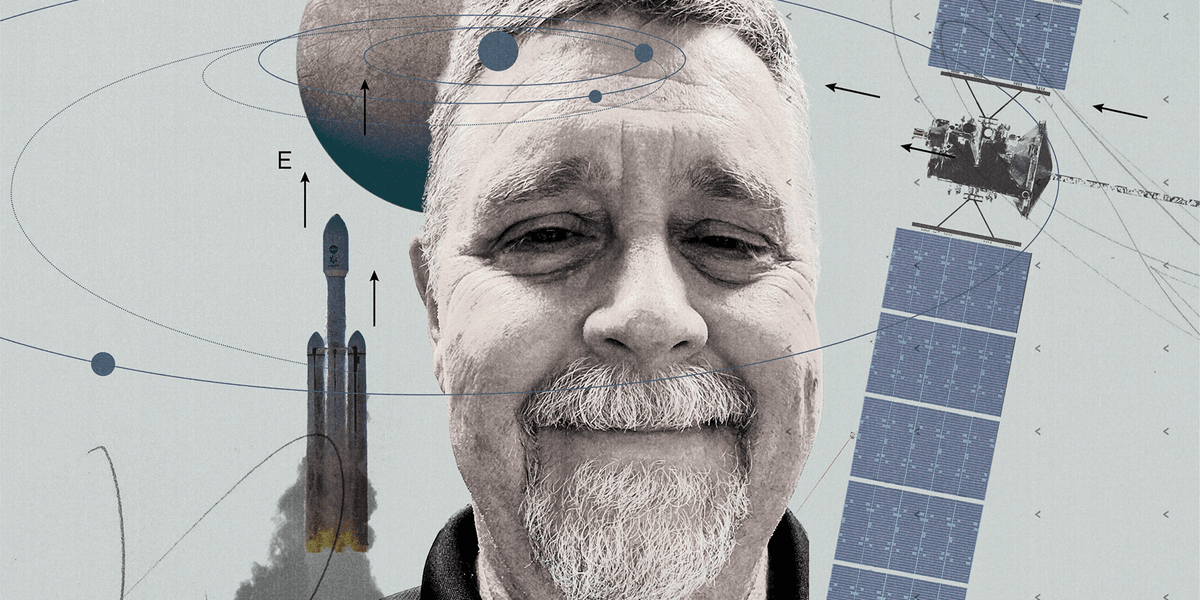
On 3 December 2026, a 30.5-meter-wide area probe will slingshot previous Earth, selecting up the pace it wants to succeed in Jupiter in 2030. The Europa Clipper is designed to analyze Jupiter’s enigmatic moon Europa and search for locations that might help life within the ocean beneath the moon’s thick shell of ice. Tim Larson is the challenge supervisor for the mission on the Jet Propulsion Laboratory, and he spoke to IEEE Spectrum about designing and flying the Europa Clipper.
Tim Larson
Tim Larson is the challenge supervisor for NASA’s Europa Clipper mission. He has been on the Jet Propulsion Laboratory in Pasadena, Calif., for over 35 years.
Why take such a roundabout path to Jupiter?
Tim Larson: That’s all pushed by the power that we received from our launch automobile, the Falcon Heavy. It set a MEGA trajectory: Mars-Earth Gravity Help. So about 4 months after launch, we flew by Mars, received an help there. Now we’re coming again in for a closing help from Earth to get on our outbound trajectory to Jupiter.
The Europa Clipper is ready to orbit Jupiter and fly by Europa about 50 occasions to review it. Why not simply orbit it instantly?
Larson: The massive problem is the radiation setting. It’s so intense that any spacecraft orbiting Europa wouldn’t final very lengthy. So the mission designers got here by way of with this idea of the flybys.
We will probably be in a three-week orbit round Jupiter, however the orbit is synchronized so that each time we fly by Jupiter, Europa is correct there. Over time, you construct up the protection of the floor that we’re finally after. We spend a comparatively brief time within the high-radiation setting, after which the remainder of the orbit is in a extra benign setting the place we will relay knowledge again right down to Earth, et cetera.
The Europa Clipper depends on solar panels to generate energy. Why not use a compact radioisotope thermoelectric generator (RTG)?
Larson: It’s a nationwide coverage to solely use RTGs whether it is completely important. Numerous the early ideas that targeted on orbiting Europa needed to go along with RTG approaches, since you’d spend a lot time within the shadow of Jupiter. As soon as we shifted over to the flyby mission strategy, it turned out photo voltaic arrays can be possible.
How are Europa Clipper’s electronics totally different from different probes?
Larson: One of many issues that we handled in our design was the extent of radiation tolerance that we needed to get in all our components. In our foremost avionics module—we name it the vault—the whole lot in there may be designed to an publicity of 150 kilorads (1,500 sieverts). To get our usual factor-of-two margin, we have been shopping for components that rated to 300 kilorads.
That brings up facet challenges, as a result of if you purchase high-radiation-tolerance variations of components, you possibly can’t at all times get the very same half performance. You might need to alter your circuits a bit bit. They usually don’t at all times have the identical kind issue, so you need to accommodate that.
How do you protect fine-grained technical data concerning the spacecraft over its yearslong mission lifetime?
Larson: By the point we launch, we attempt to get the whole lot documented. As we be taught concerning the idiosyncrasies of the spacecraft, we seize that in databases. When we now have personnel turnover, we attempt to have numerous overlap. We’re taking a look at how AI can take on this broad array of data we now have in a number of totally different codecs and areas, and extract data.
This text seems within the December 2026 print situation as “Tim Larson.”
From Your Web site Articles
Associated Articles Across the Net
