

On the flip of the final century, the car trade was nonetheless new and evolving quickly. In 1898, there have been about 50 carmakers in the USA. A decade later, that quantity had elevated fivefold. In 1901, the businesses produced 7,000 autos. By 1910, manufacturing had reached 181,000.
For a number of a long time, electric cars vied with these powered by steam and inside combustion, and no one was positive which know-how would come out on high. Steam had the legacy of locomotive know-how behind it however got here with a danger of fireplace. Steam-powered autos might additionally grow to be exceedingly sizzling, relying on the location of the boiler and the steam piping. Each gasoline and electrical automobiles confronted logistical challenges: How far might you journey with out refueling or charging? You possibly can at all times throw an additional can of gasoline at the back of the automotive, however charging a battery concerned extra planning. The infrastructure for long-distance journey was not but in place.
Earlier than the invention of the electrical starter in 1911, gasoline-powered engines needed to be began with a hand crank; as soon as operating, they had been loud and emitted noxious fumes. Absolutely electrical autos, against this, had been simple to begin; you simply turned on the primary battery change, usually with a key, and there was no foul exhaust to cope with.
Electrical carmakers searching for a strategy to differentiate their merchandise determined that these attributes made their autos good for ladies. (Electrical automobiles had been additionally marketed to medical doctors in order that they may make home calls in the midst of the evening with out waking the neighbors.) Common Electrical, which made automotive chargers based mostly on mercury-arc rectifiers, was so captivated by the thought of ladies driving electrical automobiles that the corporate created a series of advertisements that includes stylishly dressed girls plugging of their automobiles and posing with their charging stations.
In advertisements for its electrical automotive chargers, Common Electrical featured girls utilizing the gear.miSci—Museum of Innovation and Science
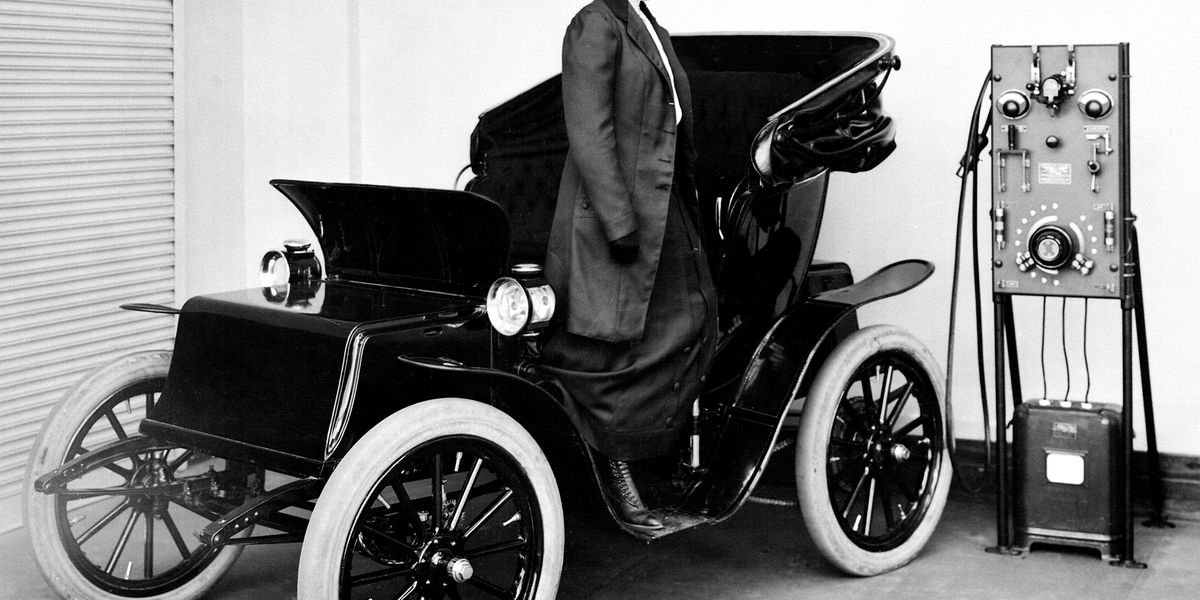
A younger girl named Fannie Goodnow was an early EV adopter. She owned a 1908 Bailey Victoria Phaeton, an open two-seater that actually did appear to be a horseless carriage, and he or she used a GE mercury-arc rectifier to cost it.
Who Invented the Mercury-Arc Rectifier?
 Electrical engineer Peter Cooper Hewitt invented the mercury vapor lamp, which turned the idea for the mercury-arc rectifier utilized in car-charging programs. Bettmann/Getty Pictures
Electrical engineer Peter Cooper Hewitt is mostly credited with the invention of the mercury-arc rectifier. In the course of the first decade of the twentieth century, Hewitt obtained a number of U.S. patents for electrical lamps and different equipment for transmitting and utilizing electrical currents. U.S. patents 968,896 and 1,163,706, granted to Percy H. Thomas, superior Hewitt’s designs. Thomas was chief electrician for the Cooper Hewitt Electrical Co., which Hewitt had cofounded with George Westinghouse to fabricate and promote his lamps.
The mercury-arc rectifier functioned as a diode. In a automotive charger just like the one Fannie Goodnow used, it transformed alternating present from the facility grid into direct present wanted to cost the automotive’s battery. A small quantity of liquid mercury contained in a glass tube would vaporize and glow as electrical energy handed by way of it. Coupled with the carbon anodes, the vapor allowed present to stream in just one course. This unit took about 12 hours to cost a drained battery.
A Carriage Maker Pivots to Electrical Vehicles
I couldn’t discover any data as to why Fannie Goodnow opted for an electrical automotive. However as a well-to-do girl dwelling within the Boston space, she had greater than a half dozen vehicle producers to select from. The one she selected was S.R. Bailey & Co. of Amesbury, Mass.
 This early electrical automotive charger used a mercury-arc rectifier to transform AC to DC.Heritage Museums & Gardens
Based on Galen Helpful, who maintains the Early Electric Vehicles web site, Samuel Robinson Bailey began within the carriage and sleigh enterprise as a youngster, successful a best-in-show prize at a carriage exhibition in Portland, Maine, in 1855. Bailey developed a fame as an inventor and designed processes to streamline the manufacture of his autos. He went into enterprise for himself in 1882. Simply over a decade later, one in every of Bailey’s carriages received a gold medal on the 1893 World’s Columbian Exposition in Chicago.
Bailey’s son Edwin attended the exposition, the place he doubtless would have seen a imaginative and prescient of the longer term: the Morrison electrical wagon. This six-passenger, battery-powered automobile ferried guests and VIPs across the fairgrounds. It wasn’t lengthy earlier than vehicles started consuming into the carriage enterprise. In December 1906, with the carriage trade collapsing, S.R. Bailey & Co. introduced it was entering into electrical autos.
Bailey’s first mannequin, the Victoria Phaeton, used an Edison alkaline battery. Thomas Edison had been engaged on a lighter, extra dependable, and extra highly effective battery for the auto industry because the Eighteen Nineties, and introduced the achievement with nice fanfare in 1903. Sadly for Bailey and different carmakers who deployed it, the battery leaked and wouldn’t maintain a cost. Edison was pressured to return to the drafting board. By 1910, he had a greater battery in manufacturing, however by then his buddy Henry Ford had launched the Mannequin T, setting the stage for the inner combustion engine to take over the market.
Whereas Edison toiled to enhance his tech, Bailey pivoted to a battery from the Gould Storage Battery Co. of Depew, N.Y. Gould additionally provided batteries for railroads, utilities, subways, elevators, and farms. Goodnow’s Victoria Phaeton used a 30-cell lead-acid battery housed in a wood field that was suspended underneath the chassis. The usual battery had a variety of 64 to 80 kilometers; a bigger battery with 50 p.c extra capability was out there for an upcharge. With the usual battery, the Victoria Phaeton value US $2,000 (about $73,000 at present, or in regards to the checklist value of an upscale EV just like the Audi Q8 or BMW i5).
 Fannie Goodnow’s electrical automotive charger now resides on the Heritage Museums & Gardens in Sandwich, Mass. However her 1908 Bailey Victoria Phaeton has been misplaced to historical past. Proven here’s a 1911 model of that mannequin.Sarah Thornington/Heritage Museums & Gardens
Goodnow put in a mercury-arc rectifier charging station within the barn adjoining to her dad and mom’ summer season dwelling in Hull, Mass. Invoice Lillie of Vintage Electric Cars notes that the charging plug was of an uncommon design. That is, in fact, one of many banes of any early adopter: nonstandardized plugs and cables. The Electrical Automobile Affiliation of America, which shaped in 1910, tried to place ahead a normal in order that electrical autos may very well be charged at any charging station. (Fashionable EV homeowners can no doubt relate.) However savvy electrical automotive homeowners knew to hold spare plug adapters and cables when touring.
When Edison’s improved battery was lastly out there, Bailey started utilizing it within the Victoria Phaeton after which went on a publicity blitz. In September 1910, the carmaker sponsored a round-trip tour from New York to Boston, with a facet journey up New Hampshire’s Mount Washington, totaling about 1,600 km. Sadly, the “This Car Climbed Mt. Washington” bumper sticker hadn’t but grow to be well-liked.
 Thomas Edison provided the batteries for an electrical automotive made by S.R. Bailey & Co., which then went on a publicity street journey from New York to Boston. miSci—Museum of Innovation and Science
Though Thomas Edison posed for a photograph with the brand new Bailey Victoria Phaeton that featured his new battery, he himself selected a Detroit Electric Victoria for his personal use. (Edison was identified to be a horrible driver, so another person doubtless chauffeured him round.)
Unable to compete towards the rising tide of Mannequin Ts, S.R. Bailey bought its manufacturing facility in 1915, having produced about 500 to 600 electrical autos.
Though the automobile Fannie Goodnow selected turned out to be only a blip in automotive historical past, I prefer to think about her driving about city in a phenomenal automotive that embodied all of the quirks of early adoption. I hope her buddies didn’t make enjoyable of her for investing in electrical simply earlier than inside combustion took off. I hope she didn’t get stranded with out the right charging cable. I have no idea what occurred to her or her Victoria Phaeton, however her charging station remained in situ till 2022, when it was donated to the Heritage Museums & Gardens in Sandwich, Mass. Now it stands prepared to inform tales of technological change and adoption that proceed to resonate at present.
A part of a continuing series taking a look at historic artifacts that embrace the boundless potential of know-how.
An abridged model of this text seems within the November 2026 print subject.
From Your Web site Articles
Associated Articles Across the Internet
