

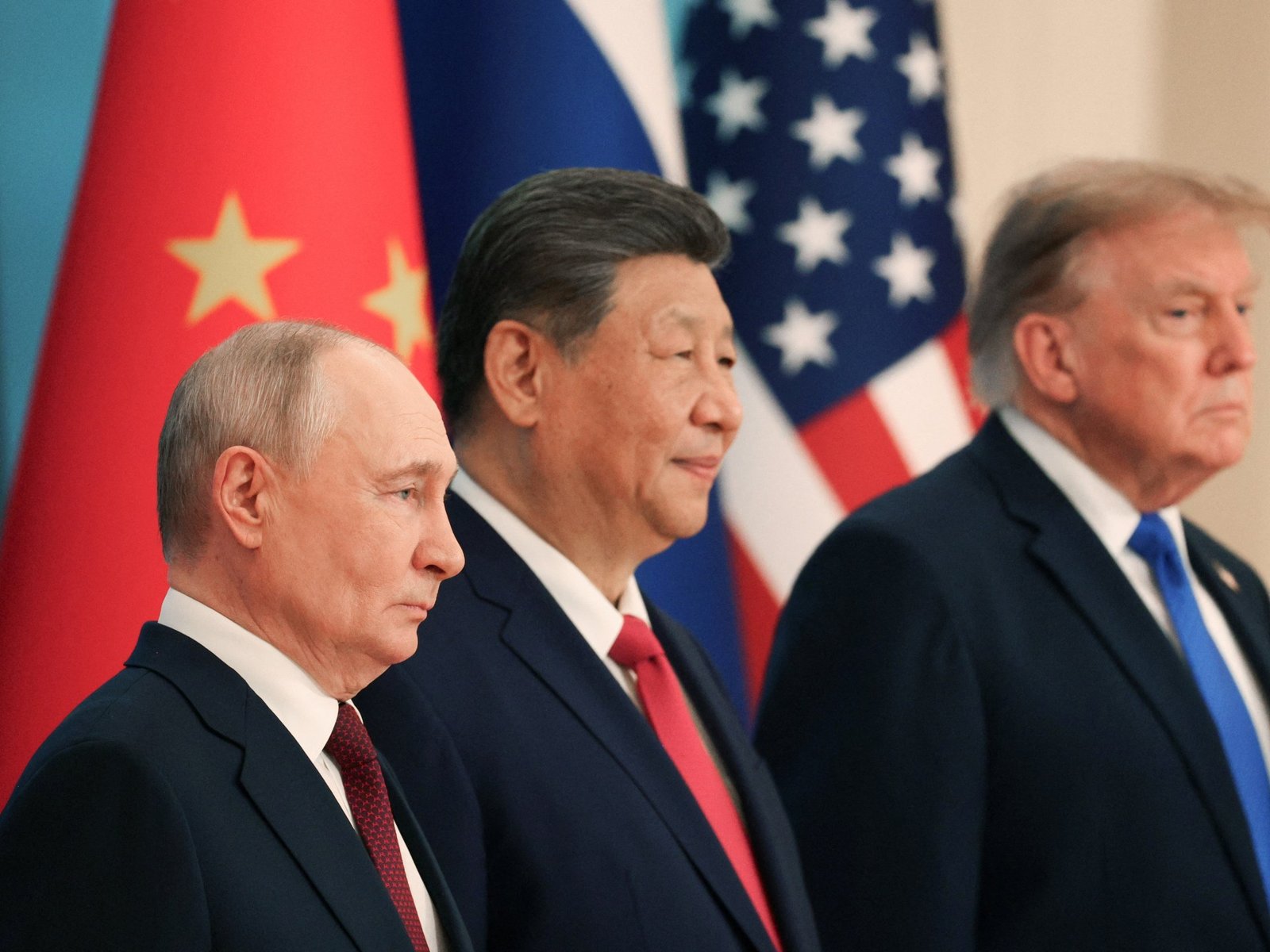
Earlier than Xi Jinping, Donald Trump and Vladimir Putin met for his or her first trilateral summit in Shenzhen, commentators had been already asking whether or not this could be “Yalta 2.0”: three nice powers dividing the world and deciding the destiny of smaller nations. When a reporter put the query to Putin, the Russian president paused and nodded. Xi, in the meantime, urged the three international locations to desert “Chilly Struggle considering”. Recalling how they’d “fought facet by facet” throughout World Struggle II, he declared: “when main international locations stay in concord, the world enjoys peace; when main international locations conflict, the world falls into turmoil.”
The summit produced the China-Russia-US Declaration towards Peace, moderately than the carve-up some had predicted. However the assembly additionally revealed a hanging distinction between the three leaders. Two had been mired in wars they might not convey to a passable finish, whereas the third was combating neither. Beijing had the burden to vary the others’ odds and had chosen to not use it.
Trump got here to Shenzhen contemporary from a midterm rout that handed each chambers of Congress to the Democrats. He’s additionally waging a battle in opposition to Iran he can not win outright. Because it erupted in February, the battle has rattled oil and power provides, drawn within the Houthis in Yemen and disrupted delivery by the Strait of Hormuz. He arrived, by one account, not chasing votes however achievements, a president working out of choices. Putin got here trailing a battle in Ukraine now in its fifth yr, remoted by the West and with an financial system shedding momentum.
Ukraine was on the agenda: the three mentioned the battle on the American president’s initiative. But the American envoys tasked with ending it, Steve Witkoff and Jared Kushner, travelled to Berlin to transient Ukraine and European leaders, who had been decided to not be excluded from choices concerning the battle. Zelenskyy, awaiting his debrief there, put it plainly: points regarding Ukraine have to be determined with Ukraine, and people regarding Europe, with Europe. Any settlement reached in Shenzhen would nonetheless must deal with the calls for of these straight concerned within the battle.
Beijing’s place on Ukraine presents one other perspective on the battle. Chinese language officers have posed the counterfactual plainly: had China chosen to arm Russia, the entrance wouldn’t look because it does at present. Strategists describe its method as “constructive neutrality”, arguing that siding brazenly would have widened the battle, whereas China’s personal crimson strains lowered the nuclear temperature.
In the meantime, the combating continued. Because the leaders met, Russian drones hit Kharkiv, and Ukraine struck oil amenities in Tatarstan and hit the Kerch Bridge for the third time in every week. The battle was being settled not on the diplomatic desk however on the bottom, which is precisely why a room in Shenzhen couldn’t carve it up.
China’s reluctance to just accept commitments on different powers’ phrases was additionally obvious within the nuclear discussions. Washington has lengthy sought a trilateral nuclear arms management framework involving Russia and China, however Beijing has refused to affix on equal phrases. Its arsenal, at an estimated 620 warheads, is a fraction of the American and Russian stockpiles of some 5,000 every, a disparity Beijing cites in declining equal phrases.
The declaration the three leaders issued coated UN reform, extra refined oil provide, opposition to what they described as abuses of jurisdiction by the Worldwide Prison Court docket, and a pledge {that a} nuclear battle “can’t be received and mustn’t ever be fought”. Critics known as it the bottom frequent denominator. They had been proper concerning the restricted substance, however Beijing had managed to convene the opposite two powers by itself phrases, with out agreeing to the division of the world that some had anticipated.
China at present occupies the place the USA held earlier than 1914 and once more earlier than 1939: the facility whose restraint, greater than anybody’s drive, is setting the phrases. The heft is actual: on purchasing-power phrases the most important financial system on Earth, a producing base roughly equal to the G7 mixed, a army main in a rising listing of classes. China may alter the trajectory of the wars now being fought. Every, in its personal method, runs by Beijing: the battle in Ukraine, the confrontation with Iran and the turbulence spilling throughout the Center East.
Beijing’s remedy of Trump on the summit was revealing. Diminished at dwelling and overseas, he was given centre stage: a welcome on the tarmac, a front-row seat on the group {photograph} and a state banquet. Commentators known as it a bunch humbling a supplicant, nevertheless it was the weakened visitor who was being given a platform. Providing Trump dignity was not an indication of submission. Beijing may afford to take action whereas conserving its leverage.
China, nonetheless, shouldn’t be with out vulnerabilities. It faces a tightening safety arc alongside its periphery, a property market nonetheless working by weak point, a youth jobs drawback and a army nonetheless reckoning with corruption in its personal ranks. Beijing’s “constructive” posture is partially a judgement that exercising its affect too freely would expose its limits.
The smaller economies of the area, those the Yalta body assumes are being carved up, are, if something, the beneficiaries. Their stability is a by-product of a restraint they’d no hand in negotiating. That could be a unusual factor to name domination.
Yalta was powers carving up a world they then fought over. Shenzhen was totally different: leaders unable to complete their wars gathered earlier than one who may tip the stability however had chosen to not. Xi expressed confidence that the seeds planted on the assembly would ultimately bear fruit, a wager, not a outcome.
The “Yalta 2.0” label endures as a result of it’s a flattering story, however the world on show in Shenzhen shouldn’t be ruled; it’s balanced. China’s biggest energy might lie within the wars it has chosen to not enter and its refusal to finish them on phrases set by others.
The views expressed on this article are the writer’s personal and don’t essentially replicate Al Jazeera’s editorial stance.
