


Q. I’m a not too long ago divorced 48-year-old lady with one son, aged 10. I earn $145,000 yearly and was given the home — my principal residence — within the divorce settlement, which is a completely paid off three-bedroom townhouse in Montreal. My ex-husband additionally pays $550 month-to-month in youngster assist that ends when my son reaches age 18. I’ve no different financial savings or investments aside from a $20,000 emergency fund. I can possible save $3,000 month-to-month in any case bills and was questioning how I ought to save and make investments this cash. Retirement savings and education savings for my son are key priorities for me. —Stefania B. in Montreal
Reply: Hello Stefania. My suggestion to your son’s schooling is to contribute $5,000 a yr to a registered education savings plan (RESP) so that you maximize the grant. The annual contribution to get the utmost grant is $2,500. Nonetheless, you possibly can return one yr at a time to select up missed grants and the grant stops changing into obtainable as soon as your son turns 17. You might be possible going to assist your son along with his education, so why not contribute to the RESP and get the federal government grant?
It’s not as clear-cut a solution in terms of saving for retirement. The usual technique is to maximise your registered retirement savings plan (RRSP) first, then your tax-free savings account (TFSA), adopted by non-registered investments. That is the best or the worst advice you can follow . It’s all depending on the way you handle your cash.
I’ll present you the textbook method, in addition to how folks extra generally behave, then you possibly can resolve which is best for you.
To set this up I assumed inflation at two per cent and funding returns of 5 per cent, made up of a mix of curiosity, dividends and capital positive factors. Your residing bills are about $71,000 yearly, after tax and funding contributions. I additionally assumed you will have the identical $71,000-a-year after-tax earnings in retirement, which might begin in January of the yr you flip 65. Canada Pension Plan (CPP) and Old Age Security (OAS) funds begin at age 65 as properly.
I calculated the outcomes of investing $30,000 a yr, plus any tax financial savings, different year-end financial savings after spending $71,000 a yr after tax, plus the $5,000 when you cease including to the RESP. This illustrates the impression of investing the RRSP tax refund. I checked out what occurs if the cash is invested into one in all three situations: 1. all of it goes right into a non-registered account; 2. the TFSA most plus the remaining quantity to a non-registered account and three. $30,000 to an RRSP and the excess to a TFSA after which to a non-registered account.
That is an instance of the textbook RRSP technique working. The calculations point out that below situation 1, placing your cash right into a non-registered account, your financial savings at age 65 are $800,400 and financial savings are spent by age 83. With situation 2, contributing to a TFSA first, you should have $902,000 at age 65 and you’ll spend all of it by age 87. With situation 3, contributing to an RRSP first, you should have $1,264,200 by age 65 and it is going to be spent by age 91.
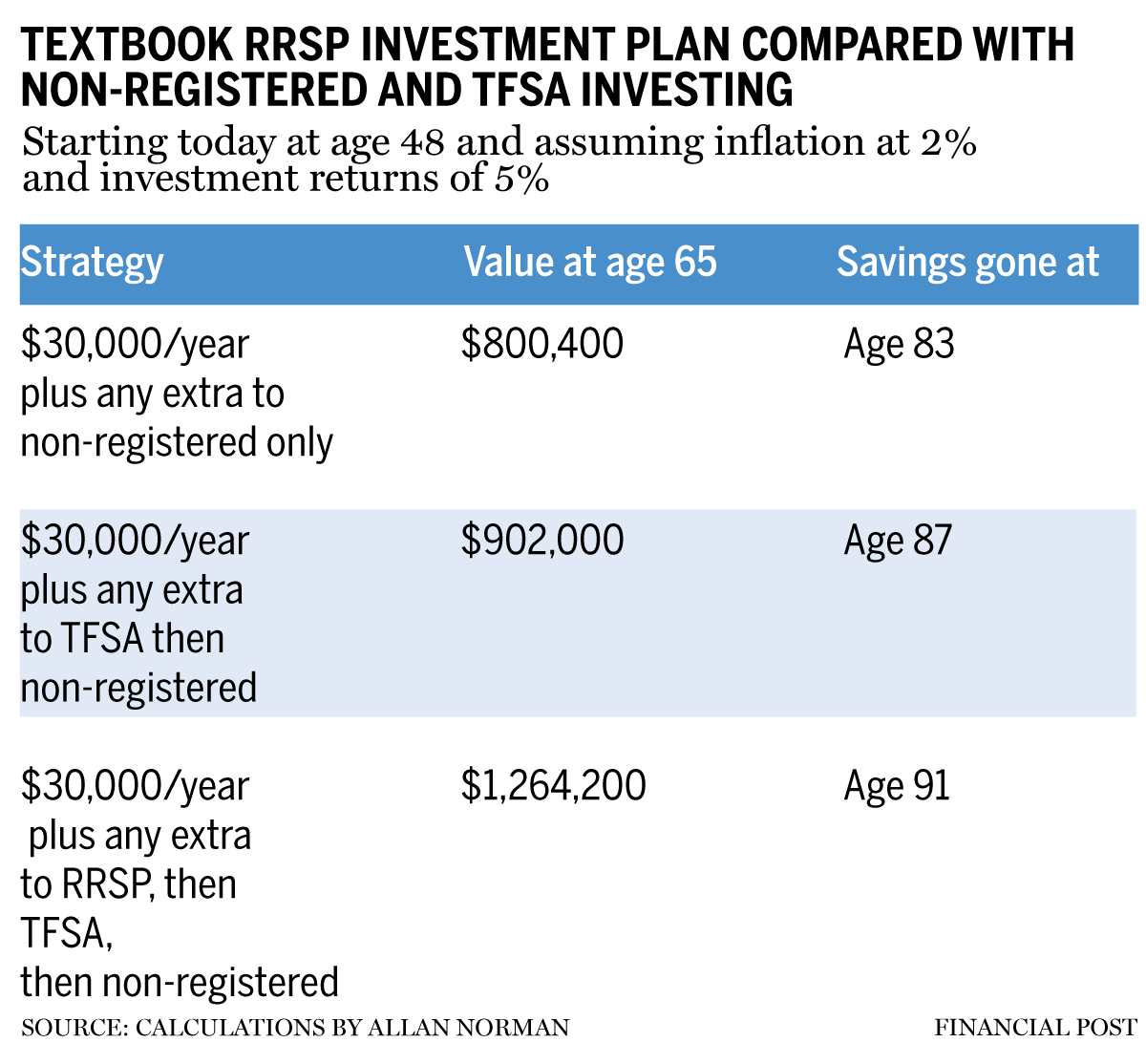
The RRSP outcomes on this situation are, I really feel, consultant of what most planners and writers current.
Nonetheless, I additionally calculated situations extra reflective of how I feel most individuals truly make investments, which isn’t to reinvest annual RRSP contribution tax refunds or year-end financial savings, if any. Additionally, as soon as the $5,000 RESP contributions cease, I didn’t add that to your retirement savings calculations.
In every State of affairs, solely $30,000 is invested annually. In situation 1, all contributions go to a non-registered account. In situation 2, you contribute as much as your TFSA restrict, then to a non-registered account. In situation 3, you contribute as much as your RRSP restrict, then to a TFSA, then to a non-registered account. The remainder is spent.
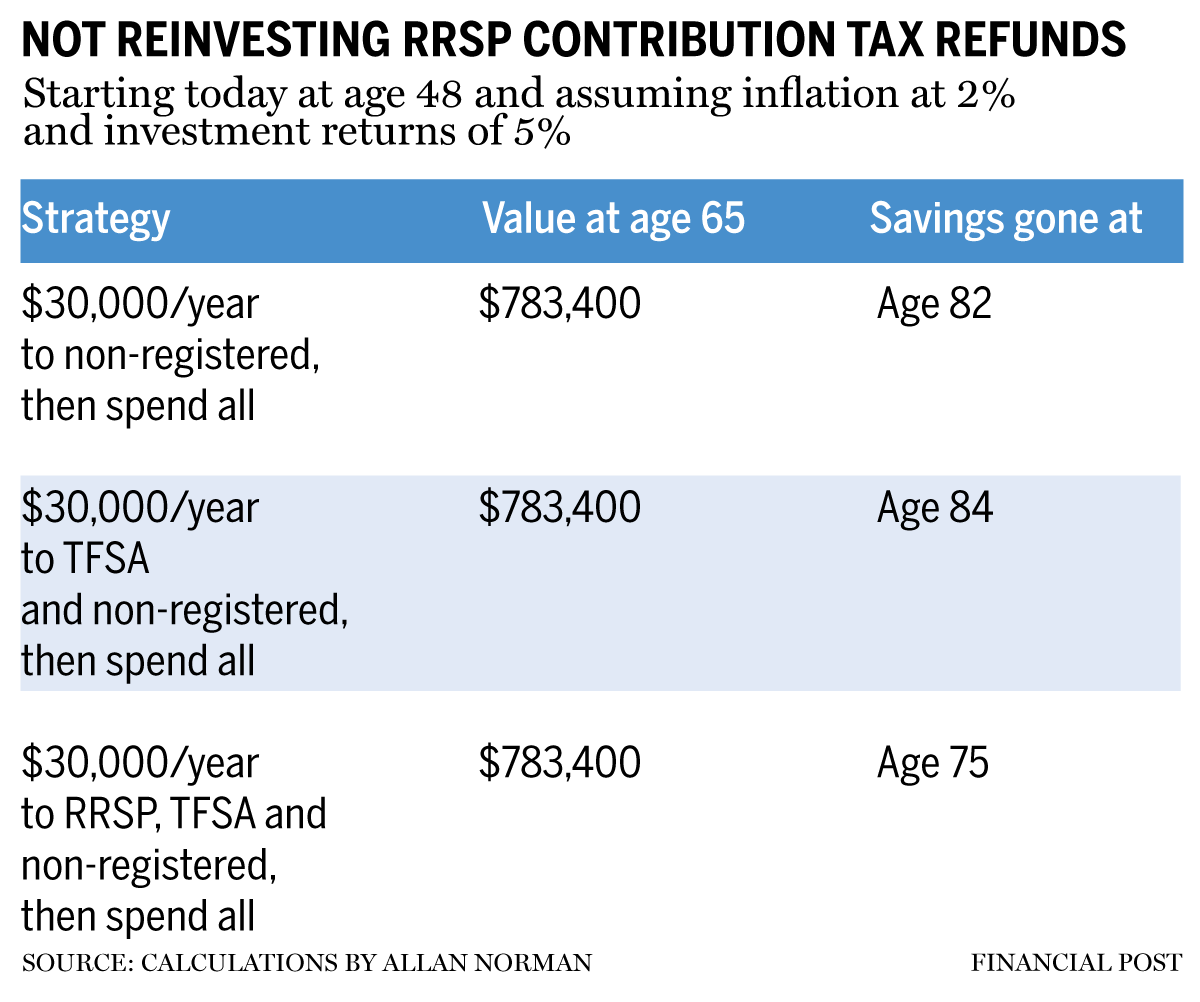
The calculations point out that below situation 1, the financial savings are passed by age 82. With situation 2, the cash is passed by age 84. With situation 3, the cash is passed by age 75. (It’s because all the cash within the registered retirement earnings fund is 100 per cent taxable when withdrawn. You need to draw a bigger quantity to cowl the tax if you need the identical after-tax earnings.)
The large take-away from these situations is that if you happen to make investments the identical fastened quantity in any of the methods you should have the identical worth at age 65: $783,400. Every account kind is taxed otherwise, which explains why your cash is operating out at totally different ages. Cash invested in a TFSA accumulates tax free and comes out tax free. Cash invested in a non-registered account has annual distributions taxed and its progress is taxed when traded or withdrawn. All the things drawn from an RRSP or registered retirement earnings fund is 100 per cent taxable.
What’s lacking from the desk are the tax implications in the course of the accumulation part. When you find yourself accumulating in a non-registered account there’ll possible be tax owing annually and if you happen to don’t pay the tax out of your funding account, which most individuals don’t, it’ll come out of your free money circulate.
The RRSP appears to be like to be a very dangerous technique if you happen to don’t reinvest the RRSP contribution tax financial savings, though the tax financial savings are important. In case your common marginal tax price is 40 per cent, a $30,000 RRSP contribution creates a tax financial savings of $12,000. That’s $12,000 further to reinvest or spend and do issues with, which can be extra necessary to you at this stage of your life.
Stefania, now that you already know this, do you assume you’d reinvest the tax financial savings if you happen to contribute to an RRSP? If that’s the case, then the textbook RRSP technique could also be finest for you. If not, chances are you’ll be higher maximizing your TFSA first. A dialog with a monetary planner turns into helpful so you possibly can design a plan to suit you and your future .
Allan Norman, M.Sc., CFP, CIM, gives fee-only licensed monetary planning companies and insurance coverage merchandise via Atlantis Monetary Inc. and gives funding advisory companies via Aligned Capital Companions Inc., which is regulated by the Canadian Investment Regulatory Organization. He will be reached at alnorman@atlantisfinancial.ca.
Do you’ve gotten a query for FP Solutions? Electronic mail wealth@postmedia.com.
