

U.S. NATIONAL TEAM TRAINING CENTER (Fayetteville, Ga.) – The epiphany came to Emma Hayes about a decade ago.
She was well into her coaching tenure at Chelsea and her team had just lost to rival Arsenal, 1-0, in the 2016 FA Cup final at Wembley Stadium.
When Hayes talks about this moment, she explains the Gunners deserved to win that game. What she couldn’t see at the time – but very clearly understands now – is why her players were so off that day. Their reaction times were slower than normal and their coordination was like “watching a group of people that looked separated from their bodies,” Hayes recently told a small group of reporters at the U.S. Soccer National Training Center near Atlanta.
“I remember in the middle of the game thinking, ‘What’s wrong with them?’” Hayes continued. “‘Is it their nerves?’”
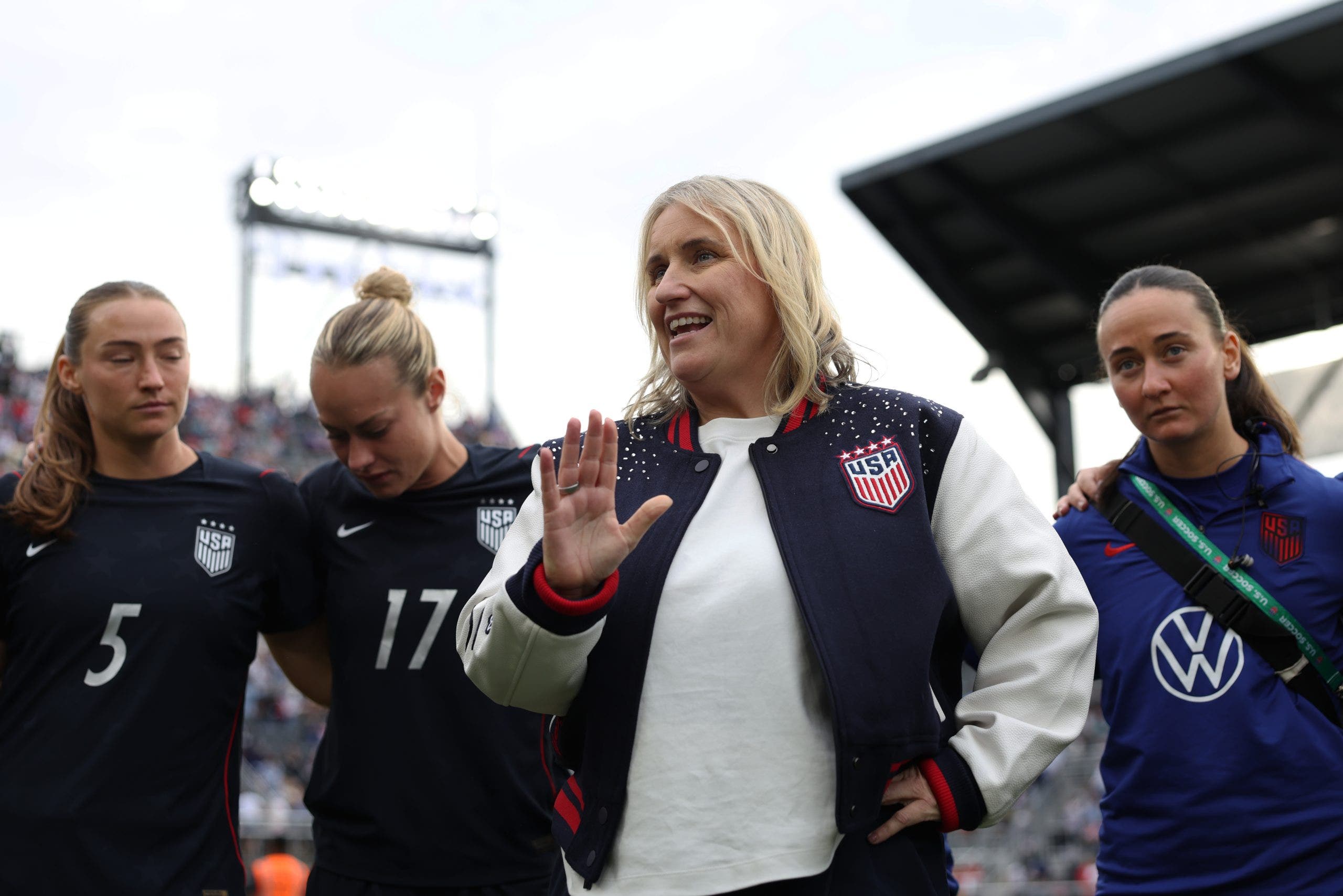
Emma Hayes and the U.S. women’s national team. (Photo by Georgia Soares/USSF/Getty Images)
Hayes later learned her players were at different points in their menstrual cycles and that, in some cases, those hormonal fluctuations were affecting their performance. She was at a loss. “Why don’t I know these things?” she asked herself.
Brain fog, fluid retention, inflammation, cramping, pelvic floor issues – these are things women know all too well. This caused Hayes to think about her own body – she’s been open about her endometriosis diagnosis – and how little she really knew. In her players’ case, they were navigating this while trying to compete at the highest level.
“We’re asking players to perform in a culture that says, ‘Oh, you’ve got a period? Sit out,’” Hayes said. “I was like, ‘It’s not good enough. We don’t want to sit out.”
Since then, Hayes has made it her life’s work to normalize conversations around women’s health and transform what was once treated as a taboo topic into a superpower.
Through her own research, she discovered there is no degree devoted solely on female physiology. If she wanted to truly understand women’s bodies, she would have to build that education herself – seeking out scientists, former players, coaches and other like-minded people who were asking the same questions.
So she did.
The result is an entire ecosystem – first at Chelsea and now as the U.S. women’s national team manager – created around putting the female lens “at the heart of everything we do.”
Part of the end goal is that this contributes to developing a team to win. The Americans are preparing for the 2027 World Cup in Brazil and then the Olympics on home soil in 2028. The squad is currently in the middle of an international window – they fell to Spain 2-0 in a friendly on Saturday and will face the defending World Cup champions again on Tuesday – before turning focus to qualifying for next summer’s tournament in November.
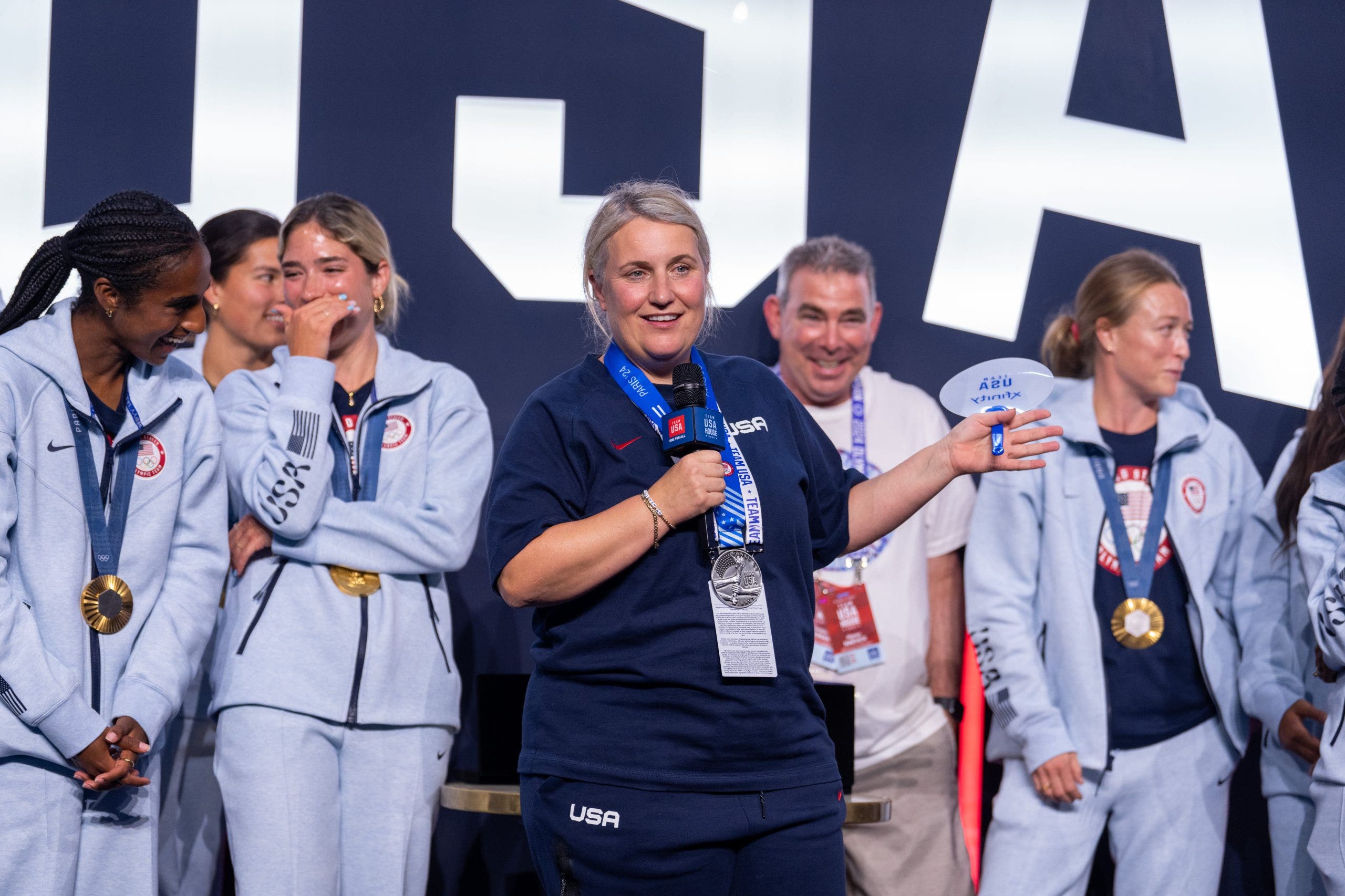
Emma Hayes led the USA to Olympic gold in 2024. (Photo by Brad Smith/ISI/Getty Images).
The other part, though, is larger than that.
Hayes and her passionate staff want to share their findings with women and girls at every level of the sport. Which is why Hayes and U.S. Soccer opened the second annual HerLens Conference – which was held internally last year – to 300 people, ranging from NWSL general managers to youth soccer coaches at the National Training Center earlier this month.
The two-day event included interactive sessions about bias and inclusivity, why girls stay or leave the game, building women- and girls-centric team culture, and more. And she introduced attendees to the term “Female 360,” a holistic approach that considers every aspect of the female player’s experience on and off the field.
“For me, this is more than winning on the pitch,” Hayes said. “This is transformational. I think my purpose, my mission, came from a losing situation and I felt robbed. I felt denied. I felt like, how have I, at this stage of my life, [not known] this stuff about myself?”
HAYES TOOK OVER because the U.S. nationwide staff head coach just a few weeks earlier than the 2024 Paris Olympics. It was a whirlwind option to start a brand new job, and she or he led a gaggle of gamers she’d solely simply met to a gold medal.
Afterward, she surveyed each participant and employees member: “OK, the place will we go from right here?”
A few months later, Hayes launched her strategy for reframing girls’s soccer by a feminine lens in an effort to not simply copy and paste a recreation inherited from males. She’s been instilling her imaginative and prescient ever since.
“It was like a light-weight bulb went off in my mind, like, ‘Yeah, duh!’” U.S. and Manchester Metropolis midfielder Sam Coffey informed me. “It was like, ‘Wow, this makes a lot sense. How am I simply recognizing this?’ It was virtually like catching my very own bias and my very own acceptance for a way issues had been up till that time.”
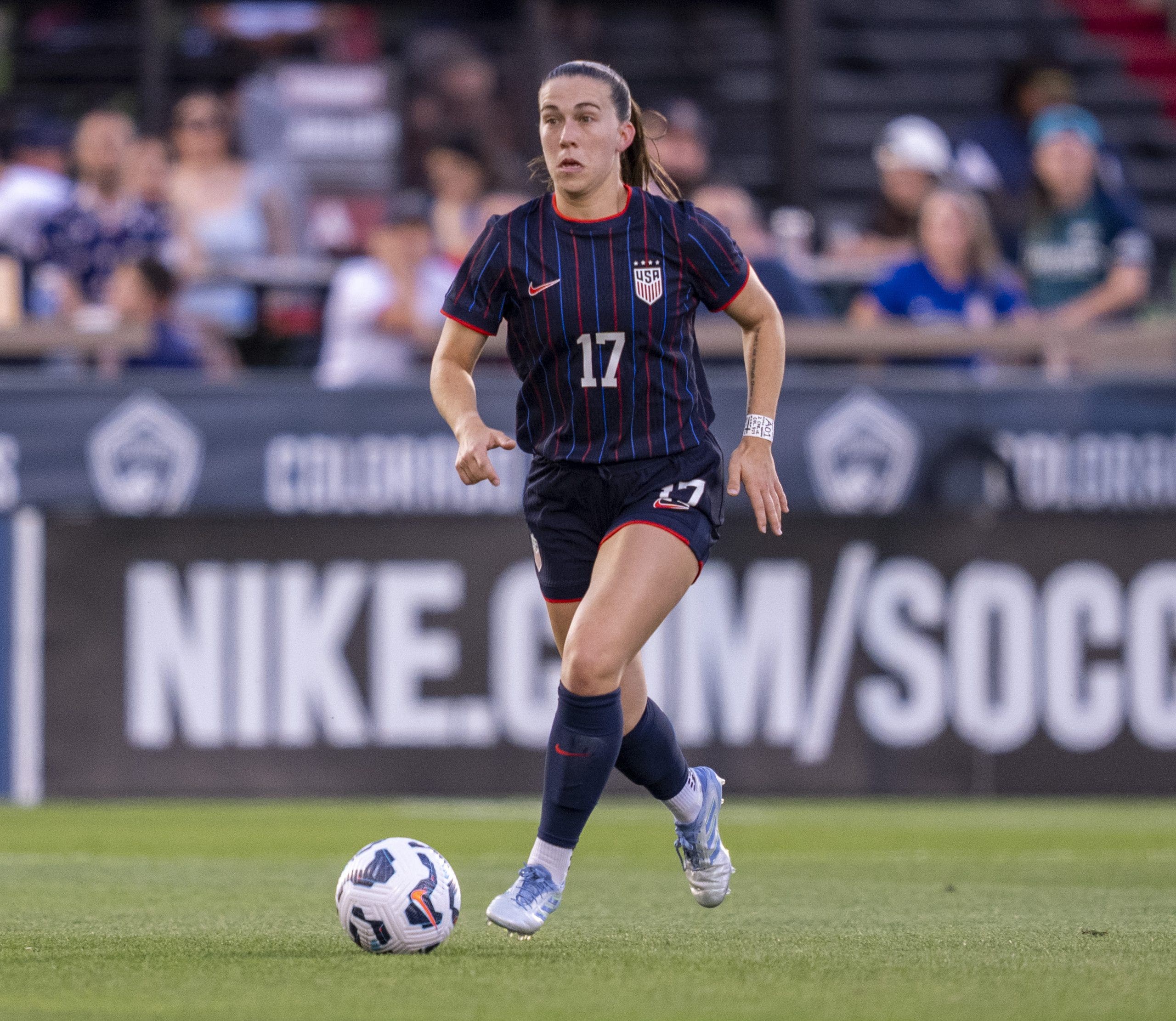
Sam Coffey is likely one of the USWNT stars benefiting from the brand new strategy. (Photograph by Brad Smith/ISI Pictures/USSF/Getty Pictures)
A basic a part of Hayes’ methodology is the popularity that ladies and men have distinct wants, from vitamin, sleep and restoration to uniforms and even the position of scales outdoors the locker room. Her employees has examined information revealing variations in how female and male gamers cross the ball into the field and the way a lot house goalkeepers take up inside it. What works for males doesn’t essentially work for girls, and constructing a greater blueprint begins with understanding these variations.
“I believe a lot of the ladies’s recreation has simply been dominated by what we all know to be true of male gamers as a substitute of, grasp on a second, these are fully completely different athletes,” mentioned Coffey, who was a part of the squad that received Olympic gold two years in the past.
“And that’s not a weak point or a drawback. It’s simply, how will we finest serve us as a substitute of how do you get the most effective out of males. As a result of we’re not males.”
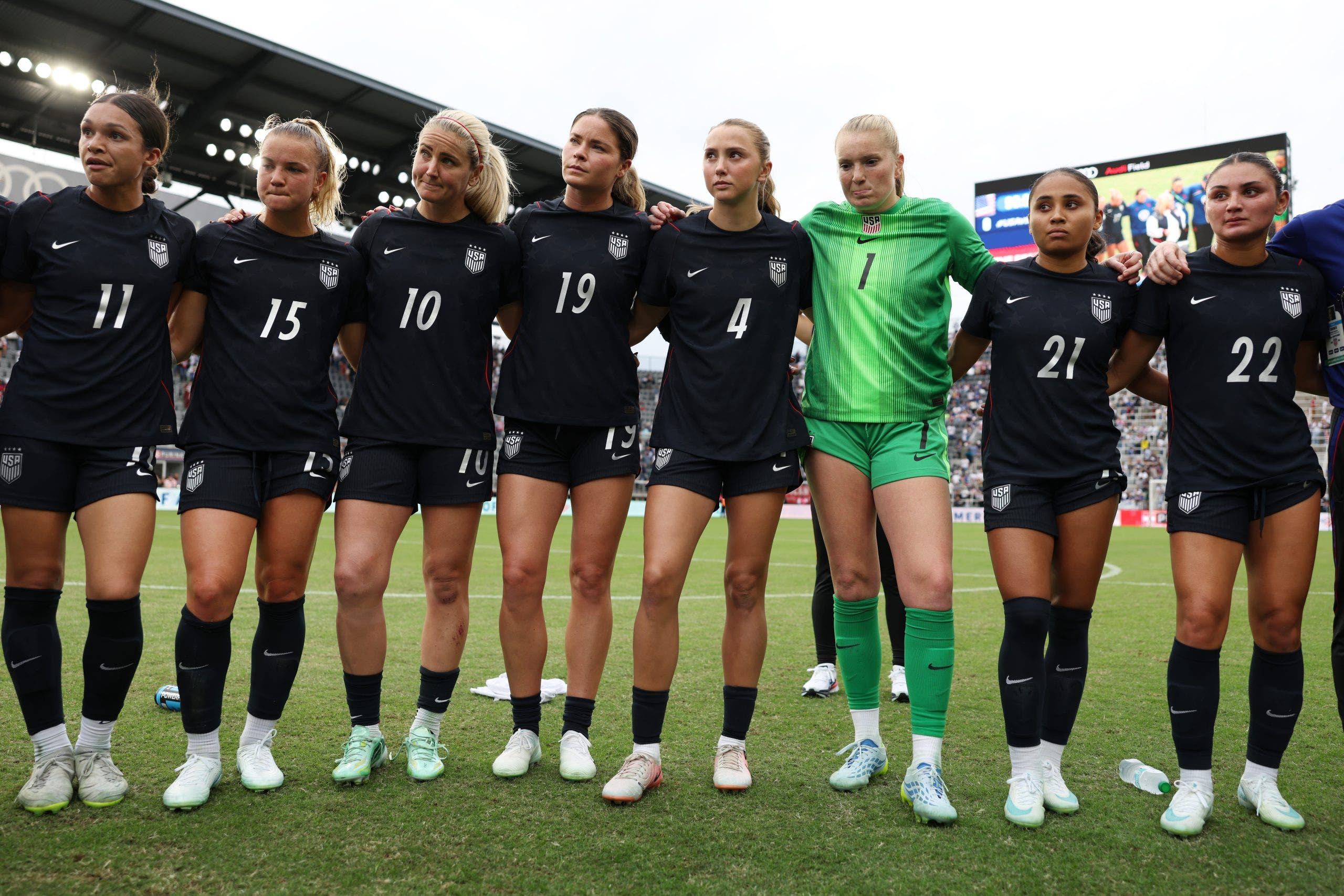
The U.S. girls’s nationwide staff forward of a match in opposition to Spain. (Photograph by Georgia Soares/USSF/Getty Pictures)
Hayes calls the senior staff her “proving lab” and the Nationwide Coaching Heart serves as an incubator for brand new concepts – an area to suppose critically, join and reimagine what’s potential. The objective is for these rules to increase past the nationwide staff, reaching youth golf equipment and soccer communities throughout the nation.
With help from the federation and its CEO and secretary basic JT Batson, Hayes hopes to rework the way forward for the sport for girls and women. The 2031 World Cup, which the U.S. plans to co-host, gives an opportunity to see how a lot progress will be made when the wants of feminine athletes are on the heart of the dialog.
“Emma desires us to be trendsetters,” Tash Patel, director of sporting analytics for the ladies’s nationwide staff, mentioned throughout her classroom session about teaching the ladies’s recreation.
That’s what this program has at all times been recognized for. From profitable World Cups to discovering methods to start out households whereas persevering with to play to preventing for equal pay, the nationwide staff has persistently pushed the sport ahead, striving to go away it higher than they discovered it and function function fashions world wide.
That is merely the subsequent iteration of that legacy.
THE IMPACT THIS has had on the gamers has been transformative. Hayes has seen their confidence develop as they’ve gained extra data, and Coffey can attest to this. She’s extra comfy talking overtly about the place she is in her cycle and the way her physique feels, whether or not she’s competing for membership or nation.
Georgie Bruinvels, the feminine well being and analysis innovation lead for the staff, has performed an integral function in spearheading a lot of this. She tracks the gamers’ cycles and Oura Ring stats – provided that they’re keen as this isn’t necessary – to higher perceive every participant’s particular person wants and methods to finest help them.
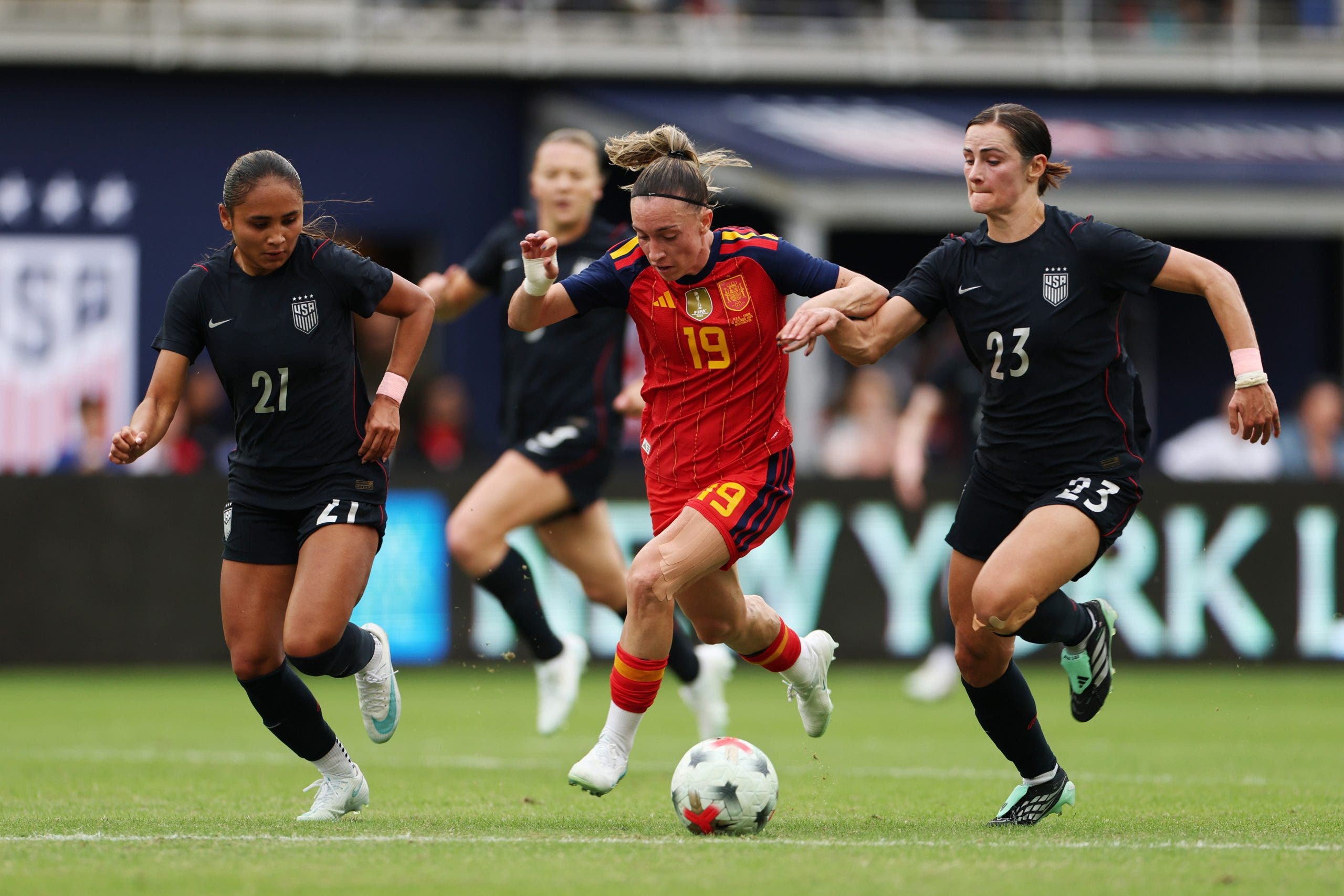
The USA will problem Spain as one of many prime groups on the 2027 Girls’s World Cup. (Photograph by Scott Taetsch/USSF/Getty Pictures)
“She’s at all times searching for little 1% methods to strategy issues from a feminine standpoint, all the way down to the temperature of our assembly room,” Coffey mentioned, noting that it ought to be 68 levels as a result of that’s the temperature that ladies course of info most effectively.
“I’ll be filling my plate for dinner and she or he’s like, ‘I might get additional anti-inflammatory meals if I had been you!’ And I am like, ‘All I would like is chocolate, however OK!’” Coffey mentioned, laughing. “All these little issues add up over time and cumulatively make such an influence on how we really feel and the way we carry out.
“They’re detailed all the way down to the T. It’s not simply taking an ibuprofen and calling it a day. And I’ve observed a distinction.”
As for a way this whole mindset is spreading throughout the game, Coffey mentioned she brings again habits from nationwide staff camp to Man Metropolis – just like the “yogurt pot” parfait recipe that Bruinvels has launched her to.
“In my membership and nation environments, I do 100% really feel like nothing is a hand-me-down,” Coffey mentioned. “It feels tailor-made to being a feminine and we’re solely going deeper in our understanding of that, which is tremendous cool.”
Whereas Hayes’ technique could find yourself giving the People a aggressive edge – as a result of not each staff or federation can have these identical sources – all of this info isn’t one thing they plan to gatekeep.
“I would like each little lady and lady, it doesn’t matter what your observe is in our sport, to really feel like that is extra than simply enjoying the sport,” Hayes mentioned.
“I believe we will influence society in a profound method.”
