

The concept of computing with gentle has been around for over 70 years, however till just lately it’s remained largely within the realm of analysis. Over the previous few years, although, optical computing has emerged as a fast-growing business: Market valuation of corporations on this sector now totals US $2.22 billion, up from $0.4 billion in 2022. One projection suggests that the market will proceed to develop exponentially within the coming years.
The rationale for this sudden surge will shock nobody: AI. Particularly, AI inference—the method of utilizing AI models to reply to consumer queries—has pushed a lot of the construction of big, power-hungry data centers, and comparatively energy-efficient optical techniques are seen as a possible manner ahead.
“A lot of the curiosity in [photonics] is pushed by the truth that AI inference has actually grow to be restricted by energy, and in a fairly placing method,” says Peter McMahon, affiliate professor of utilized and engineering physics at Cornell University, in Ithaca, N.Y., who has researched optical computing for over a decade.
Optics, not less than on paper, carries the promise of doing the identical math as as we speak’s GPUs at a drastically decrease degree of energy. Switching from electronics to optics can be a fairly radical resolution. However, like mushrooms after a rainstorm, optical-computing startups are popping up in the USA, China, Germany, and Israel. And whereas competing towards such GPU makers as Nvidia is an bold objective, the funding in optical computing has spurred growth of complementary approaches, similar to designing various AI algorithms, taking up scientific computing, and enhancing in-network computing.
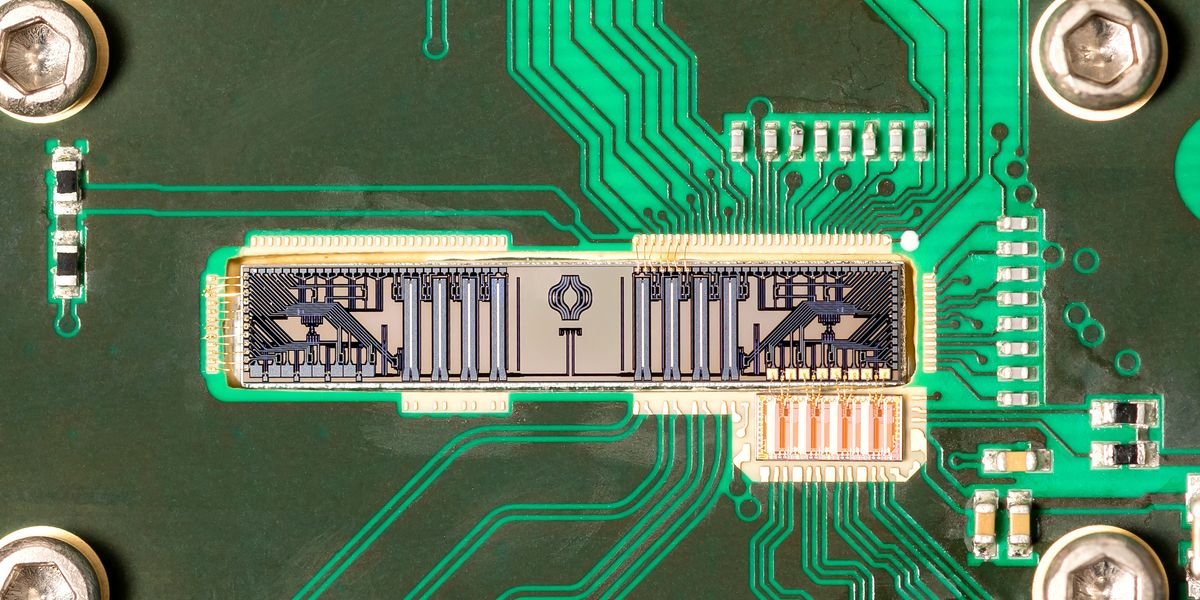
Optalysys, based mostly in England, is inserting optical-computing components into the networking path, the place information facilities already use gentle. The corporate’s primary on-chip optical aspect, proven within the inset, is a Fourier remodel calculator.Optalysys
“I believe it will be good for the know-how if many of those corporations made run at it,” says Logan Wright, assistant professor of utilized physics at Yale College, in New Haven, Conn., and a former postdoc in McMahon’s lab. “I believe that the know-how that shall be developed by this might be actually, actually helpful, and allow photonic techniques that perhaps don’t get on this wave of AI however can be able to doing actually fairly particular issues.”
Optics to inference’s rescue?
Inference makes up the majority of AI vitality use. The business is already spending billions of {dollars} designing superior GPUs and different chips to run inference as effectively as doable. On the coronary heart of the inference computation is one operation, accomplished numerous occasions a second: matrix-vector multiplication.
Again in 1978, optical-computing pioneer Joseph W. Goodman and his coworkers proposed a way for doing matrix-vector multiplication with gentle. The setup was comparatively easy. Let’s say a vector of size N must be multiplied by a matrix of measurement N by N. N light-emitting diodes, all in a row, encode the weather of the vector into the depth of sunshine—the brighter the sunshine from a person diode, the larger the worth that diode encodes. Then, a cylindrical lens spreads out the sunshine vertically, basically copying the vector N occasions. The sunshine then passes by an attenuator of N by N pixels. At every pixel, the sunshine is attenuated in accordance with the corresponding worth at that location within the matrix. Passing the sunshine by the attenuator performs the multiplication. Lastly, a cylindrical lens oriented perpendicular to the primary lens re-collects the sunshine from every row, summing it up. The ultimate vector is measured by a row of detectors.
VECTOR-MATRIX MULTIPLICATION

Probably the most computationally costly a part of widespread AI as we speak is vector-matrix (or matrix-matrix) multiplication. For a vector of size N (right here, N = 3), it takes N2 (right here, 9) multiplication steps and three accumulation steps—a number of additions directly.
The argument for why optics may be advantageous over electronics goes one thing like this: Multiplying a matrix of measurement N by N by a vector of size N takes N2 multiplication steps. In electronics, every multiplication takes some vitality, so the entire vitality used scales as N2. In optics, nonetheless, the multiplication step is passive: So long as the matrix stays the identical, passing gentle by the attenuator prices nearly no vitality. The one price is encoding the vector into gentle and studying out the reply, however the vector is of size N, not N2. So the vitality used will scale as N, not N2, as larger vectors and matrices are multiplied.
Since Goodman’s 1978 proposal, the standard of the accessible optical components has improved dramatically. Certainly, in 2022, a crew of researchers at Cornell led by McMahon demonstrated an optical neural community that consumed lower than one photon of vitality—roughly 2.5 x 10⁻¹⁹ joules—per multiplication operation. In a typical laptop, a single multiply operation can take between 10-14 and 10-12 joules, which means that optics might presumably scale back vitality use by an element of 100,000.
However McMahon cautions towards such extrapolation. First, the price of encoding information into optics was not included within the calculation. Even when the scaling is favorable with gentle, in apply it’s not simply the scaling that issues, it’s additionally the coefficients. Let’s say the vitality price of doing one multiplication with electronics is 1 picojoule, and the fee to encode one vector aspect with optics is 1,000 picojoules. The digital strategy nonetheless wins if the size N of the vector is fewer than 1,000 components.
McMahon says this instance isn’t far off from actuality: “One of many key questions is, How huge do it’s important to make the system earlier than you begin profitable? Plenty of folks have accomplished this calculation for varied sorts of neural networks. The very tough reply is someplace between N equals 1,000 and N equals 10,000.”
It’s additionally essential to remember a computing precept often called Amdahl’s law.
“Amdahl’s regulation shouldn’t even be known as a regulation. It’s a easy piece of widespread sense,” McMahon says. “When you’ve got one thing that’s going to speed up a computation, and it could actually speed up 90 p.c of the code, however there’s 10 p.c of the code that it could actually’t speed up, then the utmost doable speedup you may get is 10x.”
With AI inferencing, the purpose is to save lots of vitality, not time. However Amdahl’s commentary nonetheless applies. What fraction of as we speak’s AI inferencing code may be higher dealt with with optics is an advanced query that varies by strategy. Nevertheless it’s not 100%. Matrix-vector multiplication, or matrix-matrix multiplication, is barely a part of the inference workload—there are different, nonlinear operations that should be carried out on the information.
Taking all of those caveats under consideration, optical-computing corporations as we speak are aiming for a 10- to 80-fold enchancment in vitality effectivity over as we speak’s GPUs. The query is whether or not they can ship on that promise at scale earlier than conventional electronics catches as much as these beneficial properties.
Bridging the hole in free area
The startup Lumai, based mostly in Oxford, England, has taken maybe probably the most direct inspiration from Goodman and his crew. Lumai’s head of product, Phillip Burr, declares {that a} free-space strategy, the place the sunshine travels by air fairly than on-chip waveguides, is what’s going to allow the corporate’s tech to beat GPUs.
As an alternative of the fastened attenuator utilized in Goodman’s proposal, Lumai is utilizing a contemporary programmable gadget known as a spatial gentle modulator—a pixelated membrane akin to a flowery liquid-crystal show that may modulate each the depth and section of sunshine. The remainder of the design is extra subtle in apply however related in precept to Goodman’s design: A vector is encoded into gentle, copied N occasions by way of a lens, handed by the spatial gentle modulator, collected with one other lens, and the result’s transformed again to digital electronics. The electronics then deal with the nonlinear features. “A full vector-matrix multiply completes in a single optical cycle,” Burr says.
To precisely examine the vitality expenditures of the optical and GPU approaches, you need to first specify which a part of the workload you’re contemplating. Trendy inference is commonly break up into two phases: prefill, the place the enter question is processed and propagated by the mannequin, and decode, the place the output is generated one phrase (or token) at a time. Prefill is the extra computationally intensive of the 2. It principally includes doing vector-matrix multiplications for a similar matrix time and again. Decode additionally includes vector-matrix multiplies, however not as intensively—the time-consuming a part of decode is studying the required matrices out and in of reminiscence.
Vector-matrix multiplication with free-space optics

Chris Philpot
The Goodman optical laptop is the only model of a photonic vector-matrix multiplier. Right here, the vector components are encoded into the depth of sunshine from three gentle sources, similar to LEDs. Then, a cylindrical lens spreads the sunshine vertically. The matrix components are encoded into the opacity of an attenuator, such that when gentle passes by every pixel it’s multiplied (attenuated) by that matrix worth. Lastly, one other cylindrical lens collects the sunshine horizontally, performing the buildup step, and a photodetector measures the output vector.
Lumai, and different corporations within the area, are specializing in the compute-intensive prefill section of inference. Lumai claims that its Iris Nova optical server, made accessible for analysis in April 2026, is a proof of idea, and its next-generation Iris Aura server will do prefill utilizing roughly one-tenth of the vitality a GPU would use.
The startup Neurophos, based mostly in Austin, Texas, is placing a special spin on the Goodman laptop design. To pack extra punch right into a small gadget, the corporate is leveraging its experience in metamaterials—complicated buildings that may manipulate gentle at scales smaller than a single wavelength. The buildings it has designed are larger than a wavelength however nonetheless fairly small—simply a number of micrometers per facet.
“The equal of the optical transistor that you could get from customary silicon photonics as we speak is like 2 millimeters lengthy,” says Patrick Bowen, CEO of Neurophos. “You simply can’t match sufficient [of] them on-chip to get a compute density that remotely competes with the most recent and best [that] TSMC [Taiwan Semiconductor Manufacturing Co.] does.”

Based mostly in Austin, Texas, Neurophos is utilizing tiny metamaterials packed onto a chip to govern incoming gentle for environment friendly vector-matrix multiplication.
Neurophos
Bowen’s crew designed metamaterial-based modulators that may be programmed to govern the section and depth of sunshine on the micrometer scale, leading to an array of 1,000 by 1,000 modulators in a sq. chip with 5-mm sides. In keeping with Bowen, Neurophos’s modulators change over 10,000 occasions as quick as a typical liquid-crystal spatial gentle modulators do.
Bowen additionally claims a efficiency benefit over Nvidia’s Blackwell GPU: “We’re focusing on 50 occasions Blackwell B200’s velocity and 35 occasions its vitality effectivity, and have a highway map to achieve 250 occasions the velocity and roughly 90 occasions the vitality effectivity in subsequent generations.”
The strategy is CMOS-compatible, Bowen says, which ought to enable Neurophos to fabricate its chips on the semiconductor business’s current high-volume manufacturing strains. The corporate is at the moment selecting a website for a manufacturing facility forward of its rack deliveries to prospects in 2028.
Each Lumai and Neurophos are betting they’ll get their merchandise to market earlier than conventional CMOS can catch as much as their vitality financial savings. “Silicon will preserve enhancing, however digital effectivity beneficial properties now come slowly and at rising price,” Burr says. “Optics affords a special scaling relationship, through which effectivity improves as matrices develop. Bigger fashions, longer context home windows, and agentic workloads are all pushing prefill in that course.”
Bridging the hole on-chip
Free-space optics carries the promise of virtually energy-free multiplication, as in Goodman’s design. However one other huge advance in optics since Goodman’s work within the Seventies is built-in photonics, which lets you information and manipulate gentle on-chip.
“The secret is to do as giant a vector measurement as doable to maximise the advantage of utilizing optics, and for that cause the free-space approaches are promising,” says Yale’s Logan Wright. “Nevertheless it’s nonetheless essentially more durable” to make use of the free-space strategy, “as a result of there’s simply a lot much less infrastructure than in silicon photonics.”
Different corporations—like Shanghai-based Lightelligence and Q.ANT, based mostly in Stuttgart, Germany—are buying and selling the 3D benefit of free-space optics for the manufacturability of photonics built-in immediately onto a silicon chip.
“There’s a good cause that free-space optics are often restricted to 1,000 items a 12 months,” says Q.ANT’s CEO and founder, Michael Förtsch. “The rationale for that is lens inspection, meeting technique, and so forth. Semiconductor-manufacturable integrated photonic circuits are at this level far more promising to achieve quantity manufacturing.”
Vector-matrix multiplication with built-in photonics

Chris Philpot
One technique to do vector-matrix multiplication with gentle on-chip includes encoding vector components into the amplitudes of pulses of sunshine, touring sequentially by a waveguide. The multiplication is carried out by Mach-Zehnder interferometers: A waveguide splits in two, and the section of sunshine touring by one of many paths is shifted by a managed voltage. When the 2 paths reunite, the ensuing gentle depth relies on that section shift, performing a multiplication. Encoding the matrix components into the section shifts turns this into vector-matrix multiplication. A photodetector then collects the sunshine from all three pulses, performing the buildup step.
In Q.ANT’s strategy, the enter information is encoded into the section and amplitude of sunshine pulses by way of on-chip modulators. A vector on this scheme is represented as a sequence of such pulses, every representing one vector aspect. The sunshine is guided across the chip with waveguides. The essential computational aspect is an interferometer: A waveguide splits into two paths, and the sunshine beam touring down one path is subjected to a section shift, managed by a set voltage. When the 2 paths recombine, the ensuing interference performs a computation. Then, photodetectors and analog-to-digital converters flip the end result again into digital information. The serialized vector-matrix multiplication strategy is slower than Goodman’s laptop, the place the entire calculation occurs directly. Nonetheless, the slower velocity may be mitigated by utilizing a number of wavelengths directly, successfully encoding a number of vectors into gentle concurrently.
Q.ANT’s Native Processing Server is already being utilized in analysis establishments just like the Leibniz Supercomputing Centre in Munich and the Jülich Supercomputing Centre in Jülich, each in Germany. Earlier this 12 months, the corporate announced a industrial sale to the cloud supplier Ionos. Equally, Lightelligence’s PACE2 processor is able to multiplying 128-by-128-element matrices. In a paper launched in 2025, the corporate described vector-matrix multiplication at a 1-gigahertz frequency and 3-nanosecond latency, claiming two orders of magnitude decrease latency than with conventional GPUs.
The vitality benefit is but to be conclusively demonstrated, nonetheless, and Q.ANT’s Förtsch admits there’s nonetheless a methods to go. The primary situation is the vitality price of analog-to-digital conversion and again. So long as a quick, low-energy converter doesn’t exist, Förtsch says, “we don’t see real looking probabilities that…a basic vector-matrix multiplication machine in optics is smart.”
Past matrix-vector multiplication
Not everybody within the discipline is concentrated on matrix-vector multiplication, regardless of it being all the fashion within the AI inference world. In reality, whereas the optical vector-matrix multiply thought goes again to the Seventies, different computations with optics have been investigated way back to the Nineteen Fifties. For instance, a Fourier remodel—a standard operation that decomposes a posh wave or sign into its constituent frequencies—may be accomplished in optics with a single lens.
“A digital chip has to approximate [Fourier transforms] in lots of small steps, utilizing lots of to 1000’s of transistors and extra compute cycles,” says Q.ANT’s Förtsch. “Fashions that use such nonlinear features can attain the identical or higher accuracy with fewer parameters and fewer operations.”
Although Q.ANT’s optical processor has been used for conventional vector-matrix multiplication, the corporate believes its best benefits lie in various AI architectures that leverage extra complicated features. “Duties similar to picture classification and segmentation rely closely on operations like Fourier collection, transformations, and different nonlinear features, which photonics handles natively. We see related potential in generative AI, particularly picture and video era,” Förtsch says.
The Israel-based startup LightSolver can be focusing on algorithms which are a extra pure match for its gadget. “Should you take a look at propagating electromagnetic waves, basically, they’re operating differential equations of their nature,” says Ruti Ben-Shlomi, CEO and cofounder of LightSolver. She says differential equations may be solved a lot quicker and with larger energy efficiency on the corporate’s laser processing unit (LPU) than on a conventional laptop.
LightSolver’s LPU is an attention-grabbing twist on the Goodman optical-computer design. It has enter gentle, a programmable membrane within the type of a spatial gentle modulator, and output gentle, however the entire thing is positioned in a cavity, the place gentle bounces forwards and backwards many occasions earlier than reaching a gentle state. As well as, the crew locations a achieve medium contained in the cavity. This achieve medium features very similar to these discovered inside a laser, inflicting the bouncing gentle to construct up in depth.
 LightSolver, a startup based mostly in Israel, is utilizing free-space optics to shortly remedy differential equations by harnessing the pure properties of sunshine. LightSolver
As soon as a specific drawback is encoded into the modulator, the achieve medium is stimulated to emit random photons. They bounce forwards and backwards, growing in depth when passing by the achieve medium once more, experiencing preprogrammed adjustments by the modulator and interacting with each other till they attain a gentle state—the answer. Then, a easy digital camera takes an image of the steady-state end result. Utilizing emulation, the LightSolver crew just lately showed that their LPU can remedy differential equations 40 to 80,000 occasions as quick as a GPU, relying on the workflow. They’re now engaged on explicitly benchmarking the vitality enhancements.
LightSolver’s crew is at the moment engaged on AI purposes for its LPU as properly, utilizing the corporate’s personal algorithm to do picture era from textual content. “We’re not doing vector-matrix multiplication very quick. We’re doing one thing totally different. We have to assume that the best way you prepare the mannequin, and also you then do inference, is totally totally different. However should you do it in a different way, you’ll have the ability to do picture era with dramatic energy-consumption lower and speedup,” Ben-Shlomi says. LightSolver has a working prototype of its LPU, and the crew is engaged on a bigger, rack-mountable field.
Computing in transit
Yet one more technique to leverage gentle’s explicit strengths is being pursued by Optalysys, a startup based mostly in Leeds, England. Nick New, founder and chief product officer, has a background in free-space optics, and so he understood that taking a Fourier remodel could be very straightforward to do with gentle.
The important thing thought behind Optalysys’s know-how is taking that Fourier functionality of optics in free area and making it work on-chip. “Quite than utilizing a lens today, we have now our personal part, which is a passive part within the aircraft of the silicon that does that very same job,” New says. And by cleverly designing that part with a number of outputs, the crew found out the way to carry out totally different operations as properly. “Due to how the Fourier remodel response is generated, you may truly pull out totally different mathematical operations from it,” New says. “We will produce very giant, high-precision digital features at superhigh efficiencies, utilizing our analog photonics strategy.”
“We’re successfully including processing to the place there’s none proper now.” —Nick New, Optalysis
As an alternative of redesigning an accelerator from scratch, Optalysys is focusing on a chunk of the AI workload that’s usually already within the optical area: networking. Within the information heart, racks of computer systems are related to one another with fiber optics, and the optical connections are increasingly getting nearer and nearer to the GPUs and CPUs themselves.
Some computations already happen whereas the information is en route. These computations, which embody combining outcomes from a number of GPUs, are executed inside community change playing cards. However the playing cards naturally use energy to do this math. With passive optical elements, these computations may very well be accomplished basically totally free.
New says that along with communication between GPUs, Optalysys’s know-how may very well be used to facilitate a GPU’s communication with reminiscence, doing issues like compression and format conversion on the fly. Going again to AI inference, this strategy might enhance the decode a part of the workload. In contrast to prefill, decode is reminiscence certain: The most expensive half is shuffling mannequin information out and in of reminiscence. “We’re extra targeted on the memory-bound purposes, which inserts very properly with this precept of including processing into the communication path,” New says. “We’re successfully including processing to the place there’s none proper now.”
The probably way forward for optical computing
How probably are optical computer systems to interchange GPUs within the information heart? Yale’s Wright isn’t too optimistic. “The course of algorithm growth isn’t going to be a course that’s routinely favorable for optics,” he says. “In reality, it’s almost definitely to go in the other way, as a result of [AI model developers] need it to work higher on GPUs.”
Nonetheless, even when our AI queries aren’t going to be computed in gentle within the subsequent few years, that funding within the know-how received’t be in useless. Says Wright, “The rationale that I and plenty of different folks within the discipline are not less than considerably optimistic is that there’s actual funding from corporations like Nvidia and TSMC in growing co-packaged silicon photonics—not for computing, however for circuit switching and interconnects, and that simply type of opens the door to do some bit extra sooner or later.”
Whether or not that know-how finally ends up crunching vector-matrix multiplication, doing bespoke simulations, or performing in-network computations, the computing ecosystem appears ripe for a wide range of approaches. “We see the information heart of the longer term as heterogeneous: CPUs, GPUs and photonic NPUs [native processing units] every tackle the duties they’re greatest fitted to,” says Q.ANT’s Förtsch. “Operating every process on probably the most environment friendly {hardware} can considerably scale back vitality use and working prices.”
This text seems within the December 2026 print situation as “The Return of the Optical Pc.”
From Your Web site Articles
Associated Articles Across the Internet
