
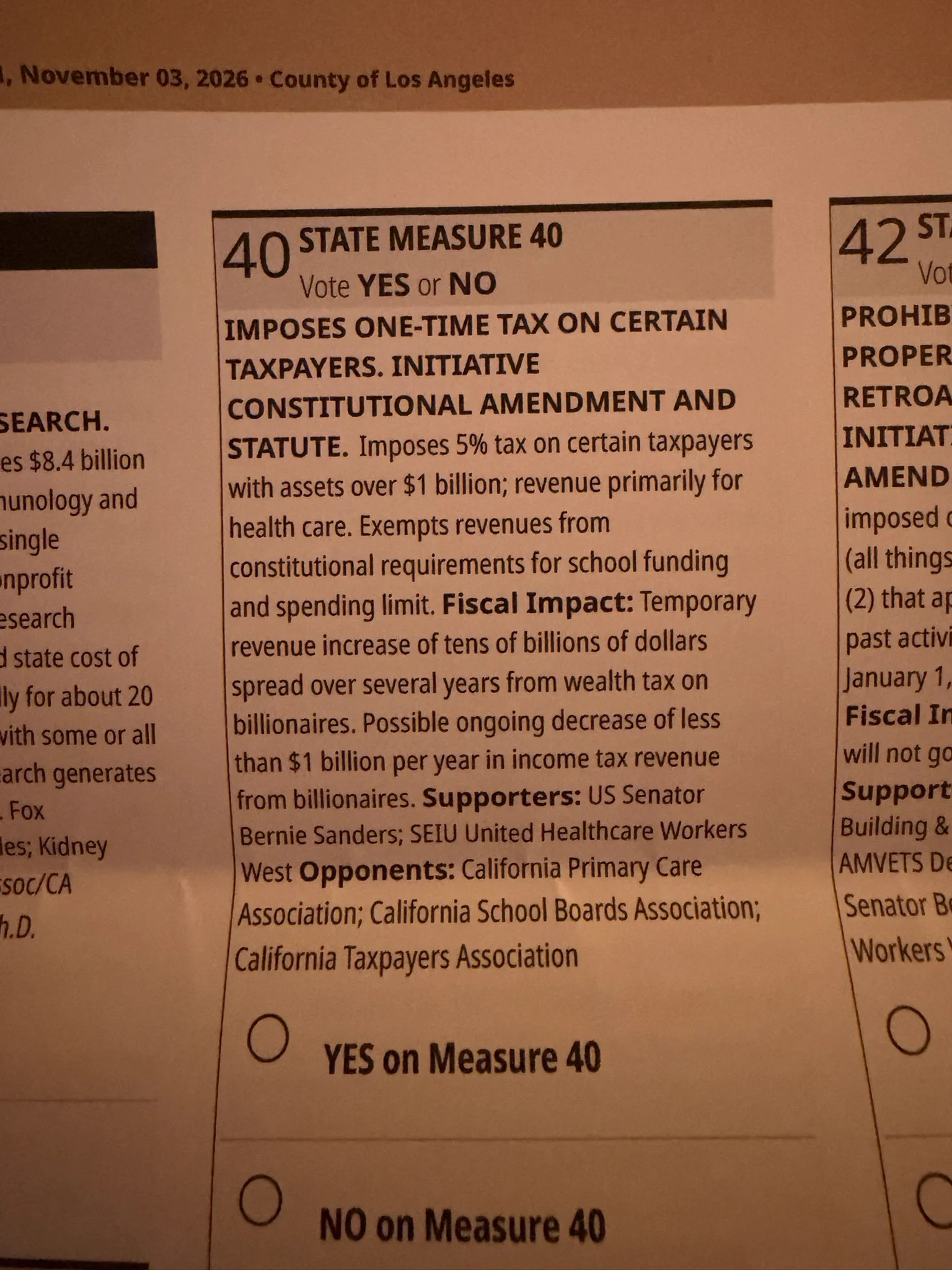
California voters have rejected the proposed 5% billionaire wealth tax, and maybe the political institution is lastly starting to grasp that capital doesn’t stay the place it’s being hunted. Proposition 40 was defeated by roughly 52.8% to 47.2%, regardless of guarantees that the federal government might elevate $100 billion just by taking a portion of the wealth gathered by its richest residents. I’ve warned repeatedly that California is driving away the very folks and companies answerable for producing its tax income. The politicians take a look at somebody’s internet price and picture it’s a pile of money sitting in a checking account ready to be seized. They don’t have any comprehension of how wealth is created, how companies are financed, or why traders relocate when governments threaten their property.
The proposal, backed by the Service Staff Worldwide Union-United Healthcare Staff West, would have imposed a one-time 5% tax on the web price of California residents holding greater than $1 billion in property. The cash was purported to offset reductions in federal healthcare funding, with extra allocations for schooling and meals help. Bernie Sanders campaigned in help of the measure, arguing that California’s wealthiest residents ought to contribute extra to public providers. But even Governor Gavin Newsom opposed the proposal, warning that it might speed up the departure of rich taxpayers and undermine the state’s funds. Think about that. California has reached the purpose the place even Newsom acknowledges that there are penalties to threatening the state’s remaining capital base.
I wrote again in January that the mere proposal of this tax was sufficient to ship monumental sums of wealth in search of a brand new dwelling. Google co-founder Larry Web page moved his household workplace from California to Delaware and commenced buying property in Florida. Peter Thiel expanded his presence in Miami, whereas David Sacks established an workplace in Austin. Larry Ellison had already shifted his principal residence to Hawaii. These people have the assets to relocate their investments and private affairs wherever the tax atmosphere is extra favorable. Enterprise capitalist Chamath Palihapitiya estimated that California risked shedding entry to roughly $1 trillion in billionaire wealth. That was an estimate of wealth doubtlessly leaving the state’s tax base, not a verified accounting of money transferred out of California. However, the warning was apparent lengthy earlier than voters went to the polls.
The socialists can not grasp {that a} billionaire’s wealth is usually tied up in possession pursuits, companies, and investments. A founder holding $10 billion in firm shares doesn’t essentially have $500 million in money obtainable to fulfill a 5% wealth tax. That individual might must promote shares, borrow in opposition to property, or liquidate investments to pay the federal government. Politicians see a quantity on paper and instantly calculate how a lot of it they’ll spend. They by no means take into account what occurs when the proprietor decides to go away. In accordance with CalMatters, rich opponents contributed roughly $378 million to defeat the measure, whereas supporters raised roughly $33.5 million. Google co-founder Sergey Brin alone contributed about $102 million to an opposition committee.
California has turn out to be dangerously dependent upon high-income earners and risky capital good points. When markets rise, tax revenues surge, and politicians develop everlasting spending applications as if these receipts will proceed ceaselessly. When markets decline or rich taxpayers relocate, revenues collapse whereas the obligations stay. The state already imposes a high marginal revenue tax price of 13.3%. Capital considers these variations when deciding the place to take a position, develop companies, and set up residency. California might have extraordinary expertise firms and universities, however these benefits don’t make it resistant to competitors.
Governments by no means need to admit that they’ve promised greater than the financial system can maintain. They determine a politically handy goal and persuade voters that confiscating extra of another person’s wealth will remedy the issue. The rich turn out to be the primary goal as a result of politicians assume the general public is not going to object. As soon as that supply proves inadequate, they need to both scale back spending, borrow extra, or develop taxation to different teams. California’s Legislative Analyst’s Workplace has repeatedly warned about structural funds issues, but the political debate stays targeted on discovering one other pool of cash. A one-time wealth tax is especially questionable when used to finance recurring expenditures. As soon as the proposed $100 billion is spent, the healthcare and schooling obligations stay. What occurs then?
The financial penalties of capital flight lengthen far past the revenue taxes paid by rich residents. Companies present employment, buy providers, finance industrial property, and generate financial exercise that produces extra tax income. When founders and traders relocate, not each worker or firm instantly follows them. However choices about the place to ascertain new places of work, make investments future capital, and develop operations regularly shift elsewhere. That’s how an financial heart loses its aggressive benefit. The injury might unfold over years, permitting politicians to disclaim duty till the decline turns into unattainable to disregard.
What is especially revealing is that the billionaire tax divided California’s personal political institution. Newsom opposed it, as did Deliberate Parenthood of California and the California Lecturers Affiliation. Their considerations included the potential lack of rich taxpayers and uncertainty surrounding the distribution of income. In the meantime, supporters argued that the cash was essential to guard healthcare providers and accused rich opponents of utilizing their monetary energy to affect the election. California wants income to help its commitments, however growing the tax burden on a small, extremely cellular group might undermine the very tax base upon which these commitments rely.
California has created a harmful dependence upon a comparatively small group of taxpayers whereas encouraging political campaigns that painting those self same taxpayers as a vast income. The federal government can not assume that the folks financing its spending commitments will stay indefinitely whatever the tax burden. Capital has no loyalty to a selected state merely as a result of a enterprise was based there. It strikes in the hunt for alternative, safety, and an inexpensive expectation that the returns on funding is not going to be arbitrarily confiscated.