


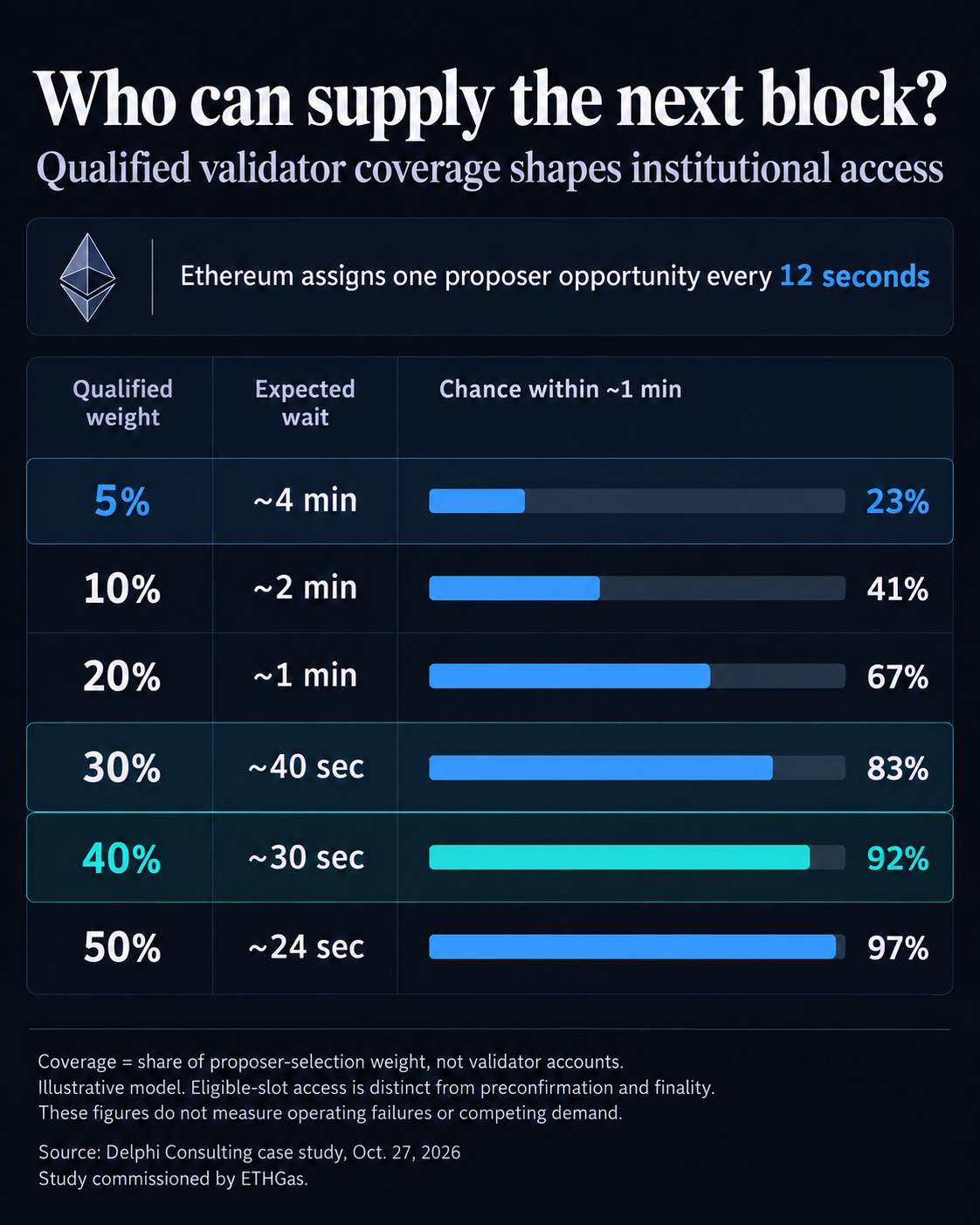
Establishments that limit Ethereum transactions to authorised block producers would face a four-minute common await an eligible slot if these operators held 5% of the community’s proposer-selection weight, in line with an Oct. 27 case examine revealed by Delphi Digital.
The mannequin identifies a constraint for ETHGas’s opt-in institutional service, which reserves Ethereum blockspace by means of operators assembly buyer necessities: shopping for capability doesn’t let a financial institution select who produces the subsequent block.
Ether.fi’s April dedication of ETH, then valued at $3 billion, provides potential provide, however the service’s availability is dependent upon how a lot lively stake meets every establishment’s necessities.
The case study’s model offers that 5% state of affairs solely a 23% likelihood of an eligible proposer inside roughly a minute. At 40% certified weight, the anticipated wait falls to about 30 seconds, and the one-minute likelihood rises to 92%.
How certified validators provide blockspace
Ethereum has one proposer alternative each 12 seconds, and the protocol selects the validator chargeable for proposing that slot’s block, with choice weighted by efficient stake. A service that accepts solely specific operators has entry to a subset of these alternatives.
The related share is proposer-selection weight, reasonably than the share of validator accounts registered with a relay.
The four-minute anticipated wait additionally averages throughout the mannequin’s alternatives. Ethereum’s known upcoming proposer schedule lets patrons plan reservations towards eligible slots. As soon as a qualifying slot is obtainable, patrons can guide it forward of execution.
For a time-sensitive collateral switch or portfolio rebalance, the sensible query is whether or not appropriate capability exists when wanted.
ETHGas announced the ether.fi agreement on April 15, saying that roughly 40% of ether.fi’s then-current ETH holdings could be dedicated to its Excessive Efficiency Staking Service for 3 years. Ether.fi additionally agreed to unique use of ETHGas’s preconfirmation platform through the time period.
ETHGas describes an opt-in institutional route with coverage screening, transaction-ordering guidelines and operator necessities earlier than block inclusion, whereas retaining settlement on public Ethereum. The meant profit is entry to current belongings and functions with extra management over how a transaction reaches them.
These controls additionally outline the provision out there to a specific buyer. A validator taking part within the wider market might not meet each establishment’s id, jurisdiction, or working necessities.
Consequently, an total participation rely can not stand in for the efficient stake eligible to serve a particular establishment.
The reliability check for public Ethereum
ETHGas advertises confirmations in about 50 milliseconds, which addresses a unique stage than discovering an eligible proposer. A preconfirmation is a dedication earlier than block inclusion, and Ethereum finality follows its own consensus process.
Quick acknowledgment can not set up rapid entry to a qualifying slot or last settlement.
JPMorgan introduced on Oct. 19 that JPM Coin, its greenback deposit token utilizing the ticker JPMD, was live on Ethereum’s main network for institutional purchasers, extending its availability past Base.
That growth places institutional cash motion on the identical public community as tokenized belongings and collateral. It additionally illustrates why execution infrastructure must be assessed towards monetary workflows with outlined timing and dealing with necessities.
The mainnet relay dashboard confirmed 221,558 all-time validator registrations and 104,728 delivered payloads in an Oct. 27 snapshot. These cumulative counters present participation and payload supply, however they do not establish present institution-qualified proposer weight or rely institutional transactions.
The subsequent helpful capability measure is the lively efficient stake eligible for a buyer’s necessities, paired with supply efficiency towards that buyer’s deadlines. Turning that chance into reliable execution requires each eligible slots and supply when establishments want them.
