

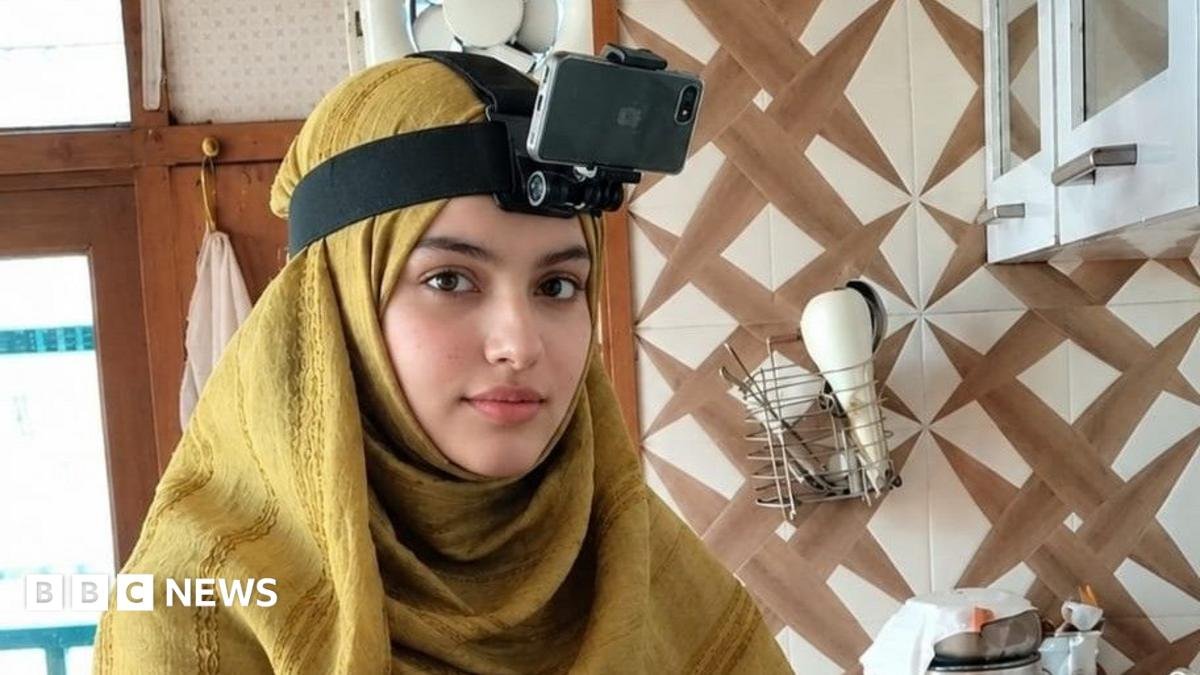
Mohammed Ashim has been slicing hair and trimming beards for 4 years in Bengaluru.
However lately the 22-year previous has been strapping a digicam to his head to document his work.
The digicam solely data his arms and fingers – his shopper’s faces are blurred out.
“The routine is straightforward, however you must be disciplined about how you progress. The operations staff taught me that my arms at all times have to remain cleanly contained in the body, the lighting must be sharp, and I can not tilt my head too abruptly whereas working.”
He wears the digicam for 5 – 6 hours a day.
“It is good cash, however actually, the sensation of doing one thing this futuristic is what retains me excited. I by no means imagined my razor strategies could be helpful to a world tech firm,” says Ashim.
He’s one among lots of of hundreds of staff internationally paid to document their actions.
Ashim’s footage is collected by a neighborhood firm, which could have lots of of individuals filming their work.
That video is then bought on to know-how firms and analysis organisations who use it to coach synthetic intelligence – specifically so-called bodily AI, a kind of synthetic intelligence that may management robots in the actual world.
Rashdan Applied sciences collects and processes such human generated knowledge.
“Each robotics firm, each frontier AI lab, has a particular form of knowledge they need: industrial duties, agriculture, family chores, small enterprise work like pottery, garment-making, embroidery, candle-making. We go wherever the duty is,” says co-founder and CEO Shahil Baig.
His firm pays $5 to $10 (£3.74; £7.47) for eight to 10 hours of recorded work.
“For lots of those folks, that is significant,” Baig says.
Ensuring staff give their consent and are comfy with the method is essential, he says.
“We document arms, not faces, and the place multi-camera rigs do seize extra of the physique or atmosphere, we blur faces out. No names, no contact particulars, nothing that identifies them personally goes into what we hand off.”
However his prospects are getting extra demanding.
“Now purchasers are asking for 4 to 6 cameras rigged round an individual’s head to cowl your entire scene, not simply the arms.
“Getting somebody to agree to 1 small digicam is one dialog. Getting them to comply with carrying what’s successfully a five-camera headset is a very completely different, and more durable, one. We pay extra for that tier of information assortment due to what we’re asking of individuals.”
And the trade is changing into extra crowded, Agarwal expects dozens extra rivals to emerge in India this yr.
